
TL;DR:
- Proper structured cleaning significantly increases tenant satisfaction and retention rates.
- Team cleaning with specialized roles improves efficiency, accountability, and cleaning quality.
- Regular inspections and tenant feedback are essential for maintaining high cleaning standards and building trust.
A single complaint about a dirty lobby or grimy restroom can be the reason a tenant decides not to renew. In multi-family properties, cleanliness is not a soft perk but a direct driver of occupancy and income. Effective cleaning boosts tenant satisfaction, with research showing that structured cleaning programs achieve 92% tenant satisfaction compared to just 71% in buildings without a defined routine. This guide walks property owners and managers through a step-by-step cleaning methodology built for multi-family commercial properties, covering preparation, daily and weekly routines, cost management, and verification systems that deliver measurable, lasting results.
Table of Contents
- What you need before you start: Preparation and tools
- Step-by-step cleaning walkthrough: Daily and weekly routines
- Cost, scalability, and staffing insights
- Verification and quality control: Inspections for lasting results
- What most property owners miss about cleaning and retention
- Get expert help for flawless commercial property cleaning
- Frequently asked questions
Key Takeaways
| Point | Details |
|---|---|
| Preparation is essential | Organizing the right tools and team setup streamlines commercial property cleaning. |
| Follow structured routines | A daily and weekly sequence boosts tenant satisfaction and lease renewals. |
| Cost reflects long-term value | Investing in consistent cleaning improves property value and reduces tenant turnover. |
| Inspections ensure quality | Routine checks and tenant feedback help maintain high standards and fewer complaints. |
| Expert help maximizes ROI | Partnering with professional cleaners ensures best practices and peace of mind for owners. |
What you need before you start: Preparation and tools
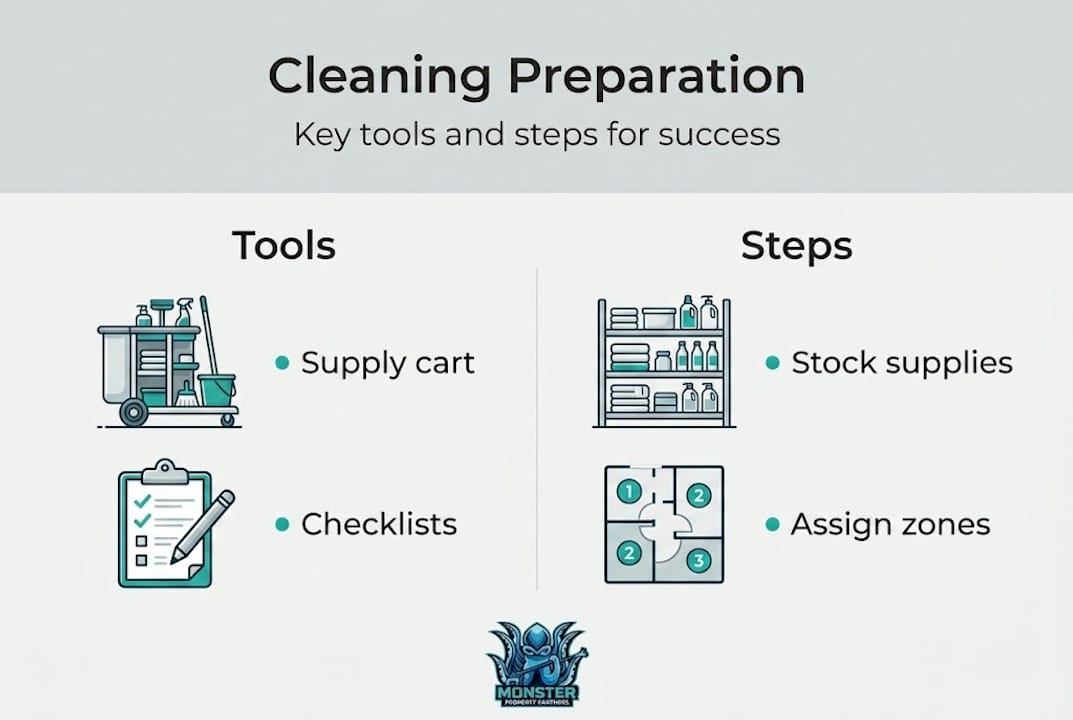
After understanding why cleaning matters, the next step is assembling the right resources for a structured routine. Jumping into cleaning without preparation is like starting a renovation without a blueprint. You waste time, miss spots, and create inconsistency that tenants notice immediately.
The team cleaning model
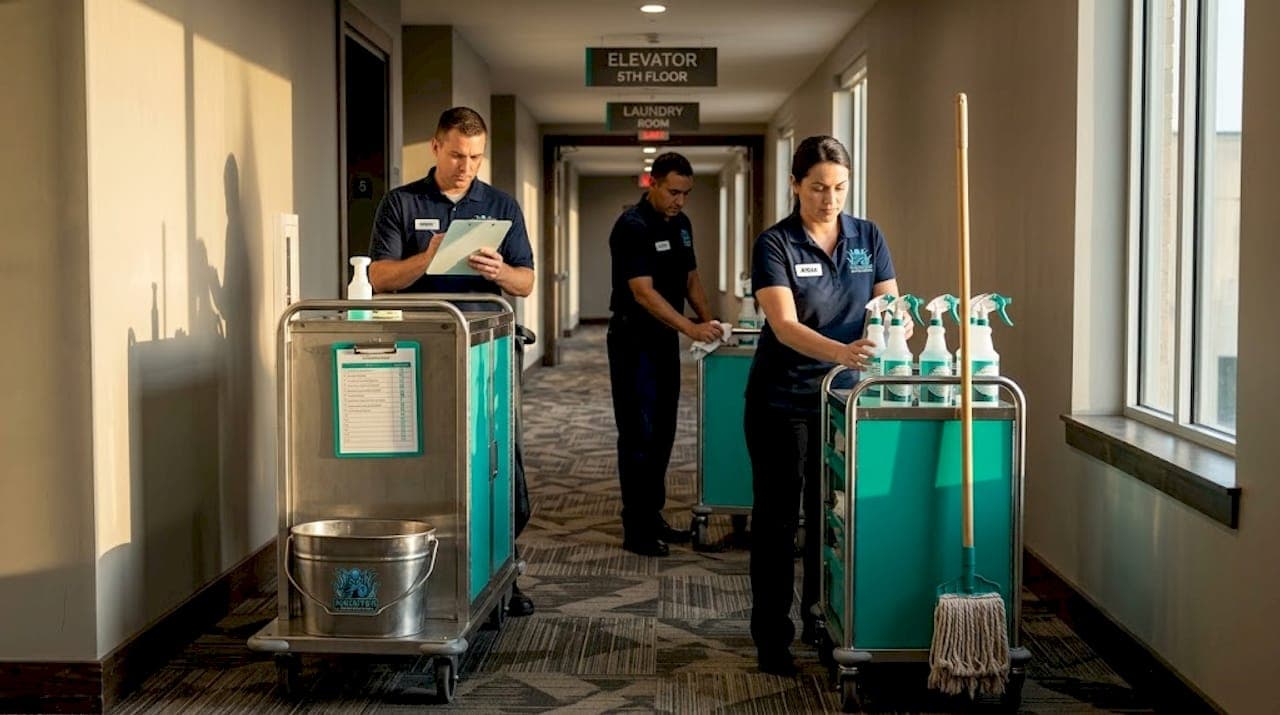
The most efficient approach for commercial multi-family buildings is the team cleaning model. Rather than assigning one person to clean an entire floor or wing, team cleaning divides tasks among crew members by function. One person handles vacuuming all hallways, another handles restrooms and touch-point disinfection, and a third manages trash removal and mopping. Team cleaning methodology follows ISSA Cleaning Times benchmarks to calculate exactly how long each task should take per square foot, eliminating guesswork and preventing bottlenecks.
This structure creates accountability. Each crew member becomes a specialist in their assigned task, which means they work faster and catch more problems than a generalist trying to do everything. For a property with 100 units and multiple common areas, this efficiency difference can mean finishing a shift in four hours instead of six.
Essential tools and supplies
Every crew should arrive with a standardized, documented supply kit. Here is the core list for a multi-family building:
- Microfiber cloths and mop heads (color-coded by zone to prevent cross-contamination)
- Backpack or upright vacuum with HEPA (high-efficiency particulate air) filtration for hallways
- Trigger sprayers with dilution-controlled chemicals for surface disinfection
- Wet floor signs and cone barriers for safety during mopping
- Trash liners, gloves, and eye protection for each crew member
- ATP (adenosine triphosphate) testing swabs for optional verification (more on this later)
- Restroom caddy with dedicated brushes, disinfectants, and paper product restocks
Pro Tip: Pre-kit your supply carts the night before a scheduled cleaning. Crews that show up to a fully stocked cart start 15 to 20 minutes faster and rarely need to make mid-shift supply runs that disrupt workflow.
Safety and compliance standards
Expert nuances: Use EPA disinfectants registered for commercial use, follow dilution protocols printed directly on product labels, and always ensure crew members wear appropriate PPE before entering restrooms or high-traffic areas. Dilution control systems, where wall-mounted dispensers mix concentrate and water at a precise ratio, reduce chemical waste by up to 30% and keep crews consistent.
Compliance also means reviewing your property cleaning guides for local OSHA (Occupational Safety and Health Administration) requirements. Access our property cleaning guides for a detailed framework aligned to commercial property standards.
| Supply category | Item | Recommended standard |
|---|---|---|
| Surface disinfection | EPA-registered disinfectant | Hospital-grade or equivalent |
| Floor care | Microfiber flat mop | Changed every 1,000 sq ft |
| Air filtration | HEPA vacuum | Minimum 0.3-micron filtration |
| PPE | Nitrile gloves, eye protection | Per OSHA 29 CFR 1910.138 |
| Verification | ATP swabs | Used weekly per zone |
Step-by-step cleaning walkthrough: Daily and weekly routines
With tools and staff in place, here is how to run step-by-step cleaning for every key zone in your building. Sequence is everything. Skipping steps or cleaning in the wrong order creates rework and inconsistency that erodes your team's credibility with tenants.
Daily routine sequence by zone
- Entryways and lobbies. Start here every time. Sweep or vacuum door mats, wipe down door handles and glass surfaces, and empty trash receptacles. This zone sets the visual tone for the entire property.
- Elevators. Wipe all interior panels (including buttons) with an EPA-registered disinfectant. Clean the door tracks with a narrow brush. Mop the floor using a damp microfiber mop.
- Hallways. Vacuum or sweep all hallways from the top floor down. This top-to-bottom approach prevents debris from upper floors being tracked onto already-cleaned lower floors.
- Restrooms (shared or common). Begin with farthest surfaces and work toward the exit. Clean mirrors and vanities first, then sinks, then toilets and urinals last. Replenish paper products and soap.
- Stairwells and laundry rooms. Sweep stairwells top to bottom. Wipe laundry machine exteriors, clean lint traps, and mop floors.
"Power clean standards define sequences (top-to-bottom, clean-to-dirty) for optimal results." Expert nuances: Use EPA disinfectants with dwell times should guide every restroom and high-touch surface clean, with disinfectants applied and left to sit for the manufacturer-specified dwell time before wiping.
Dwell time is the amount of time a disinfectant must stay wet on a surface to kill pathogens. Most products require 30 seconds to 4 minutes. Crews that spray and immediately wipe may feel productive, but they are not actually disinfecting. This gap is one of the most common errors in multi-family property cleaning.
| Task | Frequency | Zone |
|---|---|---|
| Trash removal | Daily | All common areas |
| High-touch surface disinfection | Daily | Elevators, lobbies, restrooms |
| Vacuuming / sweeping | Daily | Hallways, stairwells |
| Restroom deep scrub | Weekly | Shared restrooms |
| Floor stripping and waxing | Quarterly | Lobbies, laundry rooms |
| Window and glass cleaning | Weekly | Entry doors, lobby glass |
Pro Tip: Reference the exterior cleaning steps for your building exterior. Interior and exterior routines work best when scheduled on the same day so tenants experience a full, visible improvement all at once.
Buildings that follow this structured workflow see a measurable jump in what the industry calls "first-pass yield," the percentage of tasks completed correctly on the first attempt without rework. Structured routines consistently push first-pass yield above 85%, compared to under 60% with ad-hoc approaches. Learn more about how routine cleaning benefits both property value and tenant satisfaction over time.
Cost, scalability, and staffing insights
With routines defined, it is essential to anticipate costs and the ROI (return on investment) of consistent cleaning on property performance. Many property owners treat cleaning as a line-item cost to minimize, but the data consistently tells a different story.
Real-world cost ranges
Commercial cleaning costs range from $0.12 to $0.35 per square foot per month, with labor making up 50 to 70% of that total. For a 50,000-square-foot apartment complex, that translates to roughly $6,000 to $17,500 per month, depending on service frequency, building layout, and local labor markets.
Here is a simplified breakdown of the factors that push costs up or down:
- Service frequency. Daily cleaning costs more than three-times-per-week, but reduces tenant complaints significantly.
- Property size and layout. A single-tower building is faster to clean than a scattered-site complex with five separate buildings across a parking lot.
- Labor market. Wages vary by region. Urban markets typically run 20 to 35% higher than suburban areas.
- Cleaning products and equipment. Premium microfiber and EPA-registered chemicals cost more upfront but lower surface damage and labor time over a year.
- Specialty services. Carpet extraction, pressure washing, and grout cleaning are typically separate from base janitorial contracts.
| Property size | Estimated monthly cost (low) | Estimated monthly cost (high) |
|---|---|---|
| 20,000 sq ft | $2,400 | $7,000 |
| 50,000 sq ft | $6,000 | $17,500 |
| 100,000 sq ft | $12,000 | $35,000 |
How team cleaning makes scaling efficient
When you manage multiple properties or a large complex, the team cleaning model scales far more cleanly than individual-room approaches. You can add one specialist to a crew and immediately expand capacity across all zones without retraining an entire team. Supervisors can oversee three to four crews simultaneously, which keeps overhead low even as your portfolio grows.
Effective cleaning boosts tenant satisfaction at a rate that directly connects to lease renewals. Properties with structured programs reach 92% satisfaction, while properties without a documented routine sit closer to 71%. That 21-point gap translates into real dollars when you factor in the cost of vacancy and tenant turnover.
According to industry research, improving tenant retention with cleaning reduces the average annual turnover cost, which includes lost rent, unit preparation, and marketing, by thousands of dollars per unit. Think of your cleaning budget not as an operating expense, but as a tenant retention investment with a quantifiable payoff.
Also explore how cleanliness and tenant retention interact across different property types and markets. The connection is consistent regardless of building class or location.
Verification and quality control: Inspections for lasting results
Finally, to ensure results last, ongoing verification keeps standards high and tenants happy. Running a cleaning program without inspections is like managing a construction project without site visits. You assume things are fine until a major problem surfaces.
Setting up a zone scoring system
A zone scoring system assigns a numerical rating to each area of your property after cleaning. Restrooms, lobbies, elevators, and laundry rooms each get scored on a 1 to 5 scale across categories like cleanliness, odor, supply stock, and surface condition. Supervisors complete these scores during or immediately after each cleaning shift.
Benchmarks show structured inspections raise first-pass yield from 68% to 91% when ATP testing or formal scoring is introduced. ATP testing uses a small swab and handheld device to measure biological contamination on surfaces in seconds. A reading above 300 relative light units (RLU) on a restroom sink typically signals inadequate cleaning.
Step-by-step inspection process
- Schedule inspections. Run formal inspections at least once per week per zone. High-traffic restrooms may need daily ATP spot checks.
- Use a standardized checklist. Every inspector should evaluate the same categories in the same order. No improvisation.
- Score and document immediately. Record results digitally so scores are timestamped and trackable over time.
- Flag and correct within 24 hours. Any zone scoring below 3 out of 5 should trigger a re-clean within the next business day.
- Review trends monthly. Track which zones consistently underperform and adjust staffing or task assignments accordingly.
"What gets measured gets managed." When cleaning teams know their work will be inspected and scored, both the consistency and the quality of their output improve within weeks.
Pro Tip: Send a brief, two-question satisfaction survey to tenants quarterly. Ask them to rate cleanliness in common areas and flag any specific concerns. This creates a feedback loop that no internal inspection alone can replicate, and it signals to tenants that you take their experience seriously.
Combine your internal scoring with tenant feedback and you create a self-correcting quality system. Read more in our comprehensive cleaning guide to see how verification integrates into a full-year property maintenance calendar.
What most property owners miss about cleaning and retention
Here is the uncomfortable truth we see repeated across the properties we work with. Most owners focus their attention on deep cleaning events, things like quarterly carpet extractions or annual pressure washing days, while neglecting the daily and weekly routines that actually shape tenant perception.
Tenants do not notice the deep clean that happened six weeks ago. They notice whether the lobby smelled clean when they walked in this morning. Consistency beats intensity every single time.
The solo-cleaner model compounds this problem. When one person is responsible for everything, there is no accountability structure and no specialization. That person has every incentive to rush. The team cleaning model solves this because each member owns a specific outcome and can be measured against a clear standard.
We also see owners underinvest in verification. Skipping inspections feels like a cost savings until tenant complaints spike and a renewal falls through. The cost of one lost tenant, vacancy loss plus turnover prep, almost always exceeds a full year of inspection investment.
And do not overlook tenant communication. Sharing your cleaning schedule and inviting communicating during cleaning feedback builds trust that is nearly impossible to manufacture any other way. Tenants who feel heard stay longer. That is not sentiment, it is a retention strategy.
Get expert help for flawless commercial property cleaning
Maintaining the systems described in this article requires coordination, trained crews, and reliable scheduling across every shift and property. That is a significant operational lift, especially for owners managing multiple buildings or expanding portfolios.
At Monster Property Partners, our multifamily cleaning services are built specifically for apartment buildings and multi-family units. From concrete cleaning for apartments in common areas to full exterior cleaning programs, we bring structured methodology, team-based efficiency, and quality inspection standards to every property we serve. If you are ready to raise tenant satisfaction scores and protect your property's value, visit Monster Property Partners to get started with a team that treats your building like a long-term investment, not just a job.
Frequently asked questions
How often should common areas in a multi-family property be cleaned?
Common areas should be cleaned daily, with deeper cleaning weekly for optimal tenant satisfaction. Prioritize multi-family common areas daily to prevent complaint buildup and support higher lease renewal rates.
How much does commercial property cleaning typically cost per month?
On average, commercial cleaning costs $0.12 to $0.35 per square foot per month, with labor accounting for 50 to 70% of the total expense.
What are team cleaning and production rates in commercial cleaning?
Team cleaning methodology assigns each crew member a specific task, improving consistency and speed using ISSA production benchmarks to set clear expectations for quality and output per hour.
Why are inspections important in commercial property cleaning?
Routine inspections with zone scoring and ATP testing catch deficiencies before tenants do. Benchmarks show structured inspections raise first-pass yield from 68% to 91%, directly reducing complaint frequency.
How does cleaning affect tenant retention and property value?
Structured cleaning programs directly influence renewal decisions and rent growth. Effective cleaning boosts tenant satisfaction scores significantly, and a single-point improvement in satisfaction correlates with an 8.6% higher probability of lease renewal.