

TL;DR:
- Misjudging cleaning requirements can lead to higher costs and tenant dissatisfaction in multi-family properties. Using a structured assessment process based on key building variables ensures accurate staffing and budget allocation that meet actual needs. Regular review and adaptation of cleaning plans are essential to maintain property standards and optimize operational efficiency.
Misjudging your building's cleaning requirements is one of the most expensive mistakes a multi-family property owner can make. Too little cleaning drives tenant complaints, accelerates surface deterioration, and ultimately pushes vacancy rates up. Too much cleaning bleeds your maintenance budget without delivering proportional results. A structured, evidence-based assessment process eliminates the guesswork, protects your asset value, and keeps tenants renewing leases. This guide walks you through exactly how to size your cleaning operations correctly, using the same industry benchmarks that professional facility managers rely on every day.
Table of Contents
- Understand the key factors affecting cleaning needs
- Compile tools, measurements, and cleaning scope
- Estimate cleaning staff and costs with industry benchmarks
- Verify results and refine your approach
- Why benchmarks alone won't future-proof your building's cleaning needs
- Expert cleaning solutions for multi-family properties
- Frequently asked questions
Key Takeaways
| Point | Details |
|---|---|
| Factor in building specifics | Building size, amenities, and occupancy levels are vital for any cleaning needs assessment. |
| Use industry benchmarks | Apply standards like ISSA and APPA to set reliable staffing and service expectations for your property. |
| Gather detailed measurements | Accurate square footage and fixture counts help avoid over- or under-estimating requirements. |
| Verify and adjust regularly | Review outcomes and update your plan at least quarterly for the best results. |
Understand the key factors affecting cleaning needs
Before you run a single calculation, you need a clear picture of every variable that drives cleaning demand in your building. Skipping this step is where most self-managed assessments go wrong. Owners estimate based on gut feel or what they spent last year, without ever examining whether those figures were appropriate in the first place.
The core factors shaping cleaning requirements in any multi-family property include:
- Building size and layout: Total gross square footage, the number of floors, and how common areas are distributed all affect cleaning time directly.
- Occupancy and turnover: High turnover units require deep cleaning between tenants. Buildings with long-term residents have different needs than properties with short-stay or corporate leases.
- Common area traffic volume: Lobbies, mail rooms, hallways, fitness centers, and leasing offices experience dramatically different foot traffic than individual unit corridors.
- Special amenities: Pools, dog parks, rooftop decks, shared kitchens, and co-working spaces all add cleaning scope that a basic square footage calculation will miss entirely.
- Seasonality: Mud tracking in winter, pollen in spring, and pool chemicals in summer create seasonal demand spikes your baseline staffing plan must accommodate.
- Exterior surfaces: Parking structures, breezeways, and dumpster enclosures require regular pressure washing that sits outside typical janitorial scopes.
Getting precise data on each of these factors upfront prevents chronic under-staffing or over-staffing. Industry research confirms that APPA staffing benchmarks like Level 2 standards set approximately 16,700 square feet per custodian, while ISSA cleaning times allow property managers to calculate staffing needs with precision and avoid the costly errors that come with variable occupancy.
For a broader foundation on setting up cleaning programs, the cleaning guide for managers covers program structure in detail. You can also use the cleaning checklist for property managers as a companion reference when you start categorizing tasks by area type.
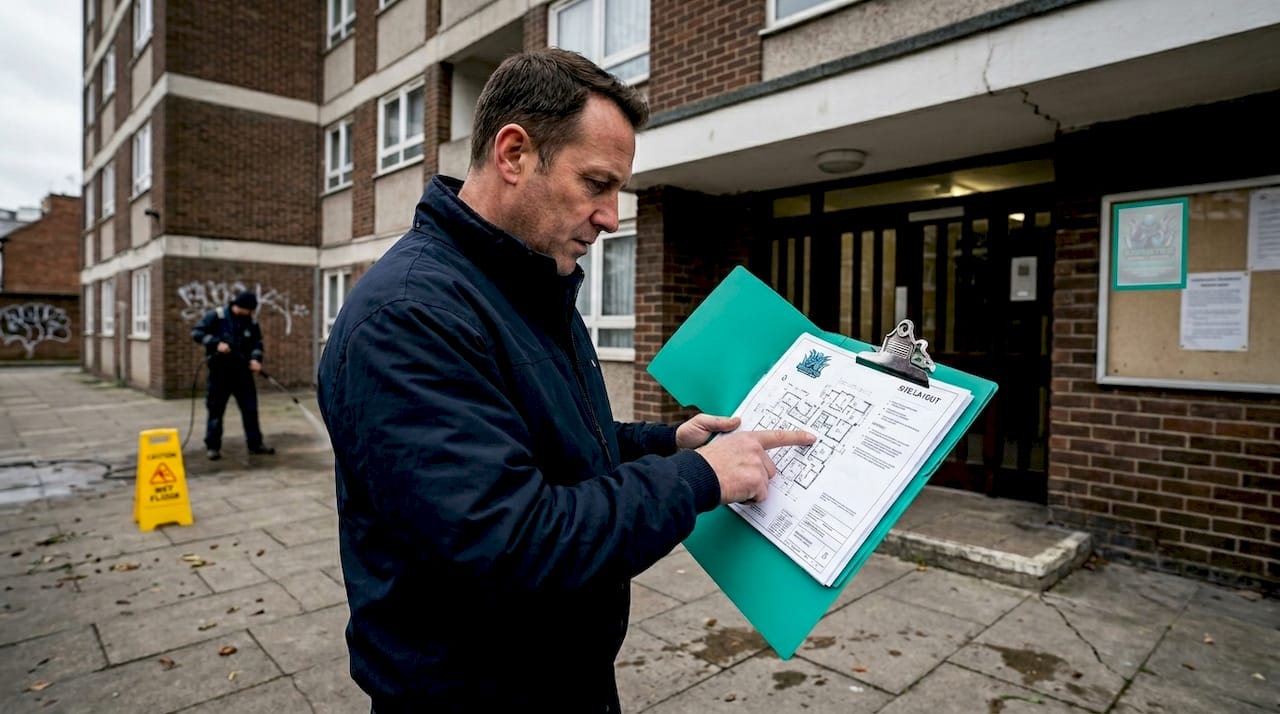
Pro Tip: Walk every floor of the building before starting your data collection. You will inevitably find amenity spaces, storage rooms, or mechanical areas that never appeared on the original floor plan but still require cleaning attention.
Compile tools, measurements, and cleaning scope
Once you understand the factors at play, the next step is gathering hard data and defining what your cleaning program actually covers. Vague scope is the number one cause of disputes with cleaning vendors and internal staff alike.
You will need the following tools and data sources to do this accurately:
- Tape measure or laser distance measurer: Use this to verify floor plan dimensions, especially in older buildings where the original drawings may be outdated or unavailable.
- Occupancy logs and lease records: Pull 12 months of occupancy data so you understand both average and peak occupancy. Buildings with 90% average occupancy but frequent turnover need different staffing than fully stabilized assets.
- Amenity inventory map: List every amenity space with its square footage and estimated daily usage. A gym used by 40 residents daily needs a completely different cleaning frequency than a rarely used business center.
- Fixture counts: Count every toilet, sink, urinal, and shower in all common restrooms. Restroom cleaning time is calculated per fixture, not per room.
- Task category definitions: Break cleaning into routine daily tasks, weekly deep cleaning tasks, and seasonal or event-driven tasks before estimating time or cost.
Here is a practical reference table for the data you need to compile:
| Item | Purpose | Sample data |
|---|---|---|
| Gross square footage by area | Baseline for staffing calculations | Lobby: 1,200 sq ft; Gym: 800 sq ft |
| Fixture count per restroom | Restroom time estimation | 3 toilets, 4 sinks per floor restroom |
| Daily foot traffic estimate | Cleaning frequency decisions | Lobby: 300 entries per day |
| Amenity usage log | Priority ranking for deep cleaning | Pool deck used 5 hours/day in summer |
| Seasonal event calendar | Staffing surge planning | Snow, spring pollen, summer pool season |
Applying ISSA Cleaning Times for workloading gives you the math backbone: vacuuming runs at roughly 3,000 to 5,000 square feet per hour depending on obstacles, while cleaning a single toilet takes about 5 minutes. These times let you calculate total labor hours needed per week based entirely on your actual building data, not someone else's guess.
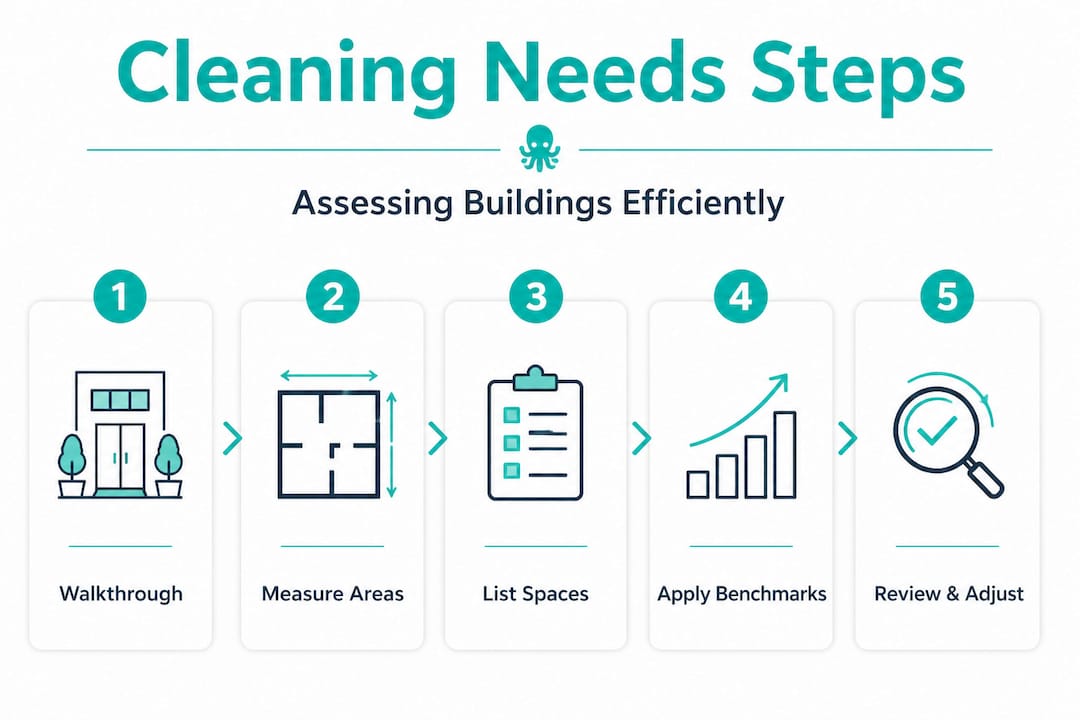
For exterior surfaces including concrete walkways, parking lots, and building facades, a dedicated assessment process applies. The guide on exterior cleaning assessments walks through exactly how to measure and scope those areas.
Pro Tip: Always add a 15% buffer to your labor hour calculations. Multi-family properties generate unexpected cleaning events constantly, from move-outs to spills in the elevator. Without buffer capacity, your regular schedule falls apart every time something unplanned happens.
Estimate cleaning staff and costs with industry benchmarks
With your building data in hand, you can now translate measurements into specific staffing requirements and realistic budget figures. This is where property owners who skipped the previous steps run into serious problems. Without verified measurements and fixture counts, any staffing estimate is just a guess.
Follow these steps to build your estimate:
- Calculate total cleaning hours per week: Use ISSA cleaning times to assign hours to each task category. Sum up routine, deep, and seasonal tasks weighted by frequency.
- Apply area-specific benchmarks: For carpeted common areas, allocate approximately 3,000 to 5,000 square feet per labor hour for vacuuming. For hard floors, mopping typically runs at 4,000 to 6,000 square feet per hour. Restrooms require 5 minutes per toilet and proportional time per sink and mirror.
- Match to APPA staffing levels: APPA Custodial Standards provide facility-level benchmarks. A Level 2 standard, which reflects ordinary tidiness, places one custodian per roughly 16,700 square feet. Use this as a sanity check against your calculated hours.
- Convert hours to FTE or contract scope: Divide total weekly labor hours by the available working hours per employee. This gives you your full-time equivalent (FTE) count. For contract cleaning, this number directly informs your bid scope.
- Apply regional labor costs: Average hourly rates for commercial cleaning staff vary by market. Multiply your FTE hours by local rates to get a weekly and annual cost estimate.
"ISSA Cleaning Times allow property managers to calculate staffing needs with precision based on square footage and task mix, enabling competitive bids that accurately reflect actual workload rather than approximations." ISSA Cleaning Times
Here is a comparison of common approaches property managers use to size cleaning needs:
| Approach | Accuracy | Risk | Best use case |
|---|---|---|---|
| ISSA cleaning times + floor data | High | Low | New assessments, vendor bids |
| APPA staffing benchmarks | High | Low | Staffing sanity checks |
| Historical cost benchmarks | Medium | Medium | Budget renewals with stable occupancy |
| Gut feel or rule of thumb | Low | High | Never recommended for multi-family |
Properties that ignore benchmarks and rely on historical costs alone tend to repeat past inefficiencies. If you were under-staffed last year and complaints were high, carrying that same budget forward without a fresh calculation locks you into the same outcome.
For streamlining how tasks get assigned and tracked after you establish the scope, the cleaning workflow optimization guide offers practical process design. You can also align your estimates with the multifamily cleaning checklist to ensure every task category is covered before finalizing your staffing numbers.
Verify results and refine your approach
Completing a cleaning needs assessment does not mean the work is finished. Every building changes over time, and the most accurate initial estimate will drift out of alignment if you never revisit it. Building a verification loop into your operations is what separates properties with consistently clean common areas from those that cycle through vendor complaints and emergency fixes.
Use the following routine to keep your assessment current:
- Track tenant complaints by category: Complaints about dirty lobbies, elevator floors, or gym equipment point to specific gaps in your current scope. Log them by area so patterns become visible.
- Conduct monthly walk-throughs: Walk every common area with your cleaning checklist and score what you observe. Areas that consistently score below standard need more labor hours allocated to them.
- Review outlier events: A move-out surge in March or a new dog park opening in the spring will temporarily or permanently shift your cleaning needs. Flag these events and adjust your allocation.
- Benchmark costs against outcomes: Track cost per square foot cleaned and set a target range. If costs creep up without a corresponding improvement in cleanliness scores, investigate staffing efficiency first.
- Update at least annually or after occupancy shifts: APPA Custodial Standards support recalibrating benchmarks when building use or occupancy changes materially. Quarterly reviews are realistic for large properties with active turnover.
Staying ahead of emerging approaches also helps. The cleaning trends for 2026 covers new tools, technologies, and tenant expectations that are reshaping what multi-family cleaning programs need to deliver.
Pro Tip: Create a shared document where maintenance staff, leasing agents, and cleaning crews all log observations about cleaning quality. This distributed feedback loop catches problems faster than any monthly walk-through can.
Why benchmarks alone won't future-proof your building's cleaning needs
Here is something most cleaning guides will not tell you directly: industry benchmarks are a starting point, not a destination. The APPA and ISSA standards we have referenced throughout this guide were developed primarily from commercial office and institutional data. Multi-family residential properties have behavioral patterns that differ meaningfully from those environments, and treating the benchmarks as fixed answers rather than calibration tools is a common and costly mistake.
At Monster Property Partners, we have seen properties that run textbook-perfect assessments every year and still fall short of tenant expectations. Why? Because their assessments are measuring the building that existed when the standards were written, not the building they actually manage today. New amenity spaces like co-working lounges, EV charging stations with shared areas, and rooftop entertainment decks have higher surface complexity than the benchmark data accounts for. They require customized cleaning approaches that no off-the-shelf formula will automatically capture.
There is also the technology factor. Green cleaning products, microfiber systems, robotic vacuums, and electrostatic sprayers are changing what a single labor hour can accomplish. Properties that update their cleaning time assumptions to reflect current equipment get far more accurate staffing models than those using labor hours calculated for older methods.
And then there is tenant expectation drift. Residents in 2026 consistently report higher cleaning standards as a factor in lease renewal decisions than residents did five years ago. That shift is not captured in a benchmark that measures square feet per custodian. It only shows up in your lease renewal rate, and by the time you notice it, the cost has already been paid.
The properties that consistently outperform on cleanliness outcomes are the ones that treat their cleaning assessment as a living document updated by feedback, technology, and real-world outcomes rather than a spreadsheet that gets filed away. Integrating sustainable cleaning for cost savings into your assessment framework is one practical way to both modernize your approach and cut operational costs simultaneously.
Expert cleaning solutions for multi-family properties
Running a thorough cleaning needs assessment takes time, data, and experience. For many property owners managing multiple buildings, the challenge is not understanding the framework but finding the capacity to execute it well across an entire portfolio.
Monster Property Partners specializes in exterior cleaning for apartment buildings and multi-family units, from large-scale pressure washing programs to common area concrete restoration. We work directly with property managers to assess what each building actually needs, not what a generic formula suggests. Our team supports every phase of the process, from the initial scope review to recurring service delivery that adapts as your property evolves. If you want expert eyes on your building's exterior cleaning requirements, explore our multifamily exterior cleaning services or learn more about our specialized common area concrete cleaning solutions to see how we approach high-traffic surfaces.
Frequently asked questions
What is the most important benchmark for estimating building cleaning needs?
APPA Custodial Standards and ISSA cleaning times work together to provide precise staffing estimates, with APPA setting area-based custodian ratios and ISSA providing task-level time allocations that prevent under- or over-staffing in multi-family settings.
How often should I re-assess my cleaning needs for a building?
Reassess at minimum annually, and immediately after any major occupancy change, new amenity addition, or significant shift in building usage patterns to keep your staffing and budget aligned with actual conditions.
What tools help gather cleaning requirements for large properties?
Floor plans, 12-month occupancy logs, amenity usage records, fixture counts, and a laser distance measurer are the core tools for assembling accurate, property-specific data before any cleaning calculation begins.
How do cleaning needs change with fluctuating occupancy?
Higher occupancy increases foot traffic, surface soil rates, and restroom usage simultaneously, requiring proportional increases in cleaning frequency and labor hours rather than a simple flat adjustment.