
TL;DR:
- Implementing a standardized cleaning workflow prevents chaos and ensures consistent quality.
- Regular audits, proper training, and workflow maintenance improve resident satisfaction and compliance.
- Using automation and clear standards optimizes efficiency, accountability, and long-term cleaning performance.
A resident complaint about a sticky lobby floor at 7 AM. The maintenance director scrambles, the cleaning crew gets pulled from scheduled tasks, and the whole morning falls apart. Sound familiar? Workflow breakdowns like this cost property managers time, money, and resident trust every single day. A standardized apartment building cleaning workflow prevents exactly this kind of chaos. When every team member knows the sequence, the tools, and the verification steps, you stop reacting and start leading. This guide walks you through preparation, execution, special area handling, and troubleshooting so your team delivers consistent results on every shift.
Table of Contents
- Preparing for efficient cleaning: Tools, teams, and standards
- Step-by-step cleaning workflow: Sequence, timing, and quality control
- Addressing special areas and high-traffic challenges
- Troubleshooting workflow breakdowns and common mistakes
- A fresh perspective: Why your cleaning workflow never stays fixed
- Support for every stage of your apartment cleaning workflow
- Frequently asked questions
Key Takeaways
| Point | Details |
|---|---|
| Follow a top-down process | Cleaning begins with ceilings and lights, moves to surfaces, and ends with floors for best results. |
| Benchmark with APPA standards | Using APPA Levels 2-3 helps set and measure realistic cleanliness targets for multi-family common areas. |
| Prioritize high-complaint areas | Focus daily work on lobbies, restrooms, and trash rooms to increase tenant satisfaction and reduce issues. |
| Leverage automation for consistency | Task automation tools help reduce missed cleans and improve audit readiness in large portfolios. |
| Monitor and adapt | Regular quality checks and updating protocols are key to sustaining a reliable cleaning workflow. |
Preparing for efficient cleaning: Tools, teams, and standards
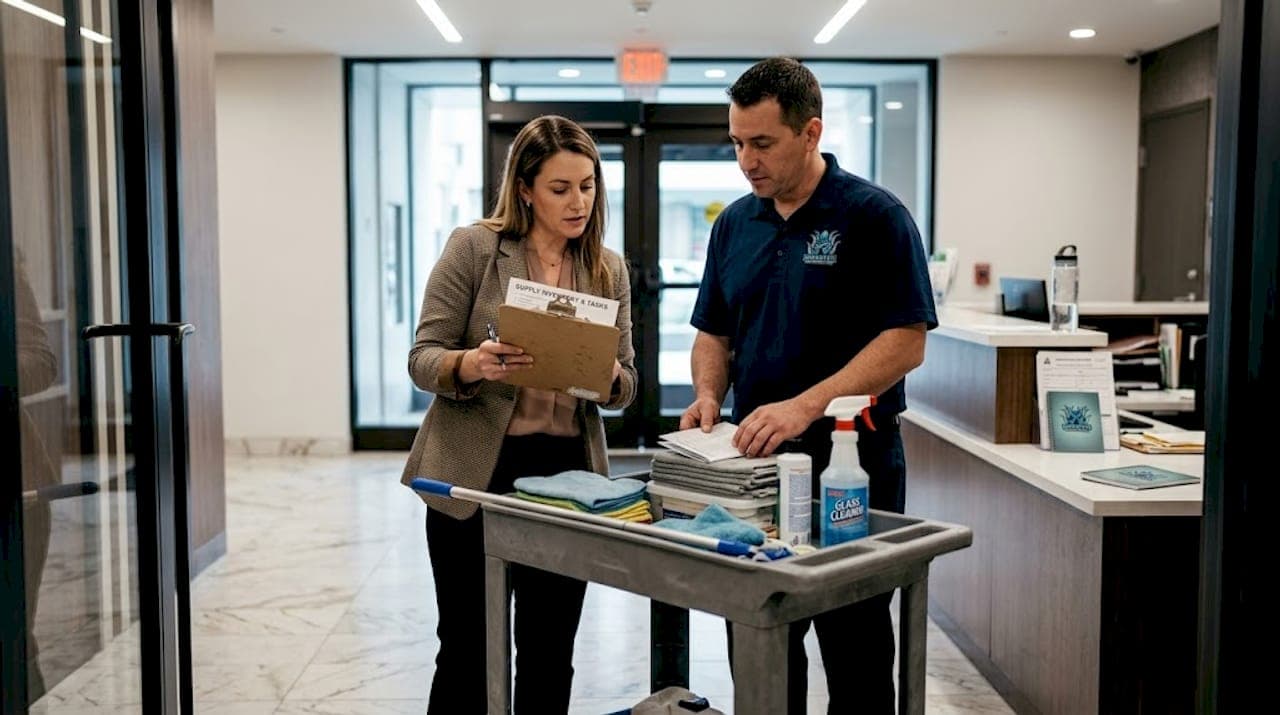
Before any mop hits a floor, the best property managers have already made three decisions: what standard they are targeting, who owns each area, and whether supplies are stocked. Skipping this setup phase is where most workflow breakdowns begin. A rushed start means missed zones, wrong chemicals, and staff doubling up in one area while another sits untouched.
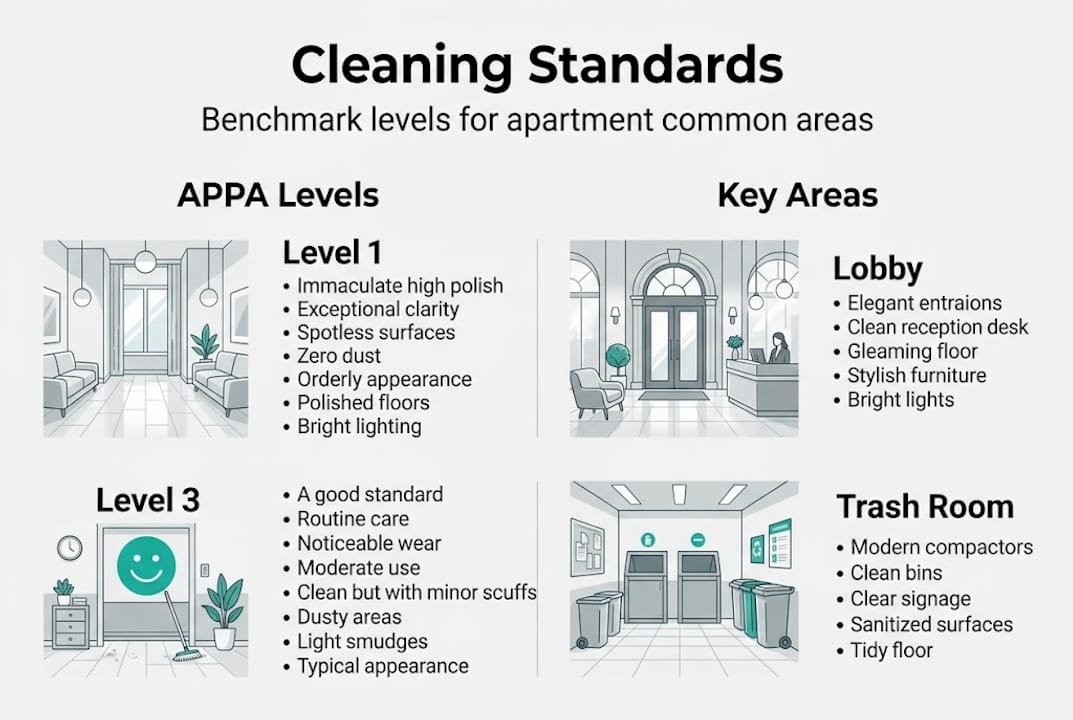
The APPA Custodial Standards provide five defined cleanliness levels for benchmarking. Level 3, described as "casual inattention," is generally the minimum acceptable target for multi-family common areas. Level 2, "ordinary tidiness," is a realistic goal for clubhouses, leasing offices, and model units where first impressions matter most. Knowing your target level by zone makes quality control objective rather than a guessing game.
The cleaning workflow methodology that prevents cross-contamination is the top-to-bottom progression from ceiling to floor and from clean spaces to dirty ones. This is not optional. Cross-contamination from skipping this sequence is a direct path to resident health complaints and compliance issues.
Here is a quick reference for tools and roles by area:
| Area | Key supplies | Team role |
|---|---|---|
| Lobby | Microfiber cloths, glass cleaner, mop | Lead cleaner |
| Hallways | Vacuum, all-purpose spray, mop | General cleaner |
| Trash rooms | Heavy-duty degreaser, disinfectant, gloves | Sanitation specialist |
| Clubhouse | Upholstery brush, glass cleaner, sanitizer | Lead cleaner |
| Laundry room | Lint brush, degreaser, mop | General cleaner |
Before every shift, run a pre-clean walkthrough. Confirm supply levels, verify staff assignments, check that equipment is operational, and flag any areas with maintenance overlap. Use a cleaning checklist essentials document to standardize this step across shifts.
Pro Tip: Prioritize restrooms, kitchens in common areas, and trash rooms during your walkthrough. These three zones generate the most resident complaints and carry the highest compliance risk if neglected.
Step-by-step cleaning workflow: Sequence, timing, and quality control
Once preparation is locked in, execution needs to follow a repeatable sequence. Improvised cleaning feels productive but misses critical zones and wastes time. A numbered workflow keeps every team member aligned regardless of experience level.
- Ceiling and overhead fixtures: Dust vents, light fixtures, and ceiling fans. Remove cobwebs with an extension duster.
- High surfaces: Wipe down shelving, signage, and window frames.
- Mid-level surfaces: Clean counters, appliances, door handles, mailboxes, and elevator button panels.
- Glass and mirrors: Use streak-free glass cleaner on doors and lobby mirrors.
- Vacuuming: Address carpets and rugs before any wet work.
- Mopping: Work from the far end of the space toward the exit.
- High-touch point disinfection: Light switches, door handles, elevator buttons, and intercom panels get a final disinfectant wipe.
Move-out cleans follow this same sequence but take considerably longer. A standard 2BR move-out typically runs 2.5 to 4.5 hours and is priced at 1.75 to 2.5 times a recurring clean. Budget for this in your turnover schedule.
Do not rush turnover cleans. Move-out cleans are 1.75 to 2.5 times the price of a recurring service visit. A rushed job that fails inspection means a second visit, doubled cost, and delayed unit availability.
For task tracking, here is how manual and automated systems compare:
| Feature | Manual checklists | PMS automation |
|---|---|---|
| Setup time | Low | Medium |
| Error rate | Higher | Lower |
| Real-time updates | No | Yes |
| Audit trail | Paper only | Digital log |
| Staff accountability | Supervisor-dependent | System-enforced |
Cleaning scheduling automation through a property management system can auto-generate tasks, send reminders, and log completions in real time. PMS task automation removes the human error that paper checklists introduce at scale.
For quality control, build in a daily spot check covering 10 to 15 percent of cleaned areas. Run a full audit weekly with documented sign-off from the team lead. Review the manager cleaning guide for audit templates that map directly to APPA level targets.
Pro Tip: Rotate which zones get spot-checked daily so staff cannot predict when oversight happens. Unpredictable audits produce more consistent results than scheduled ones.
Addressing special areas and high-traffic challenges
Not every square foot of your property carries equal risk. Lobbies, trash rooms, and laundry areas are the highest-complaint zones in multi-family buildings, and they require a different cleaning frequency than hallways or stairwells.
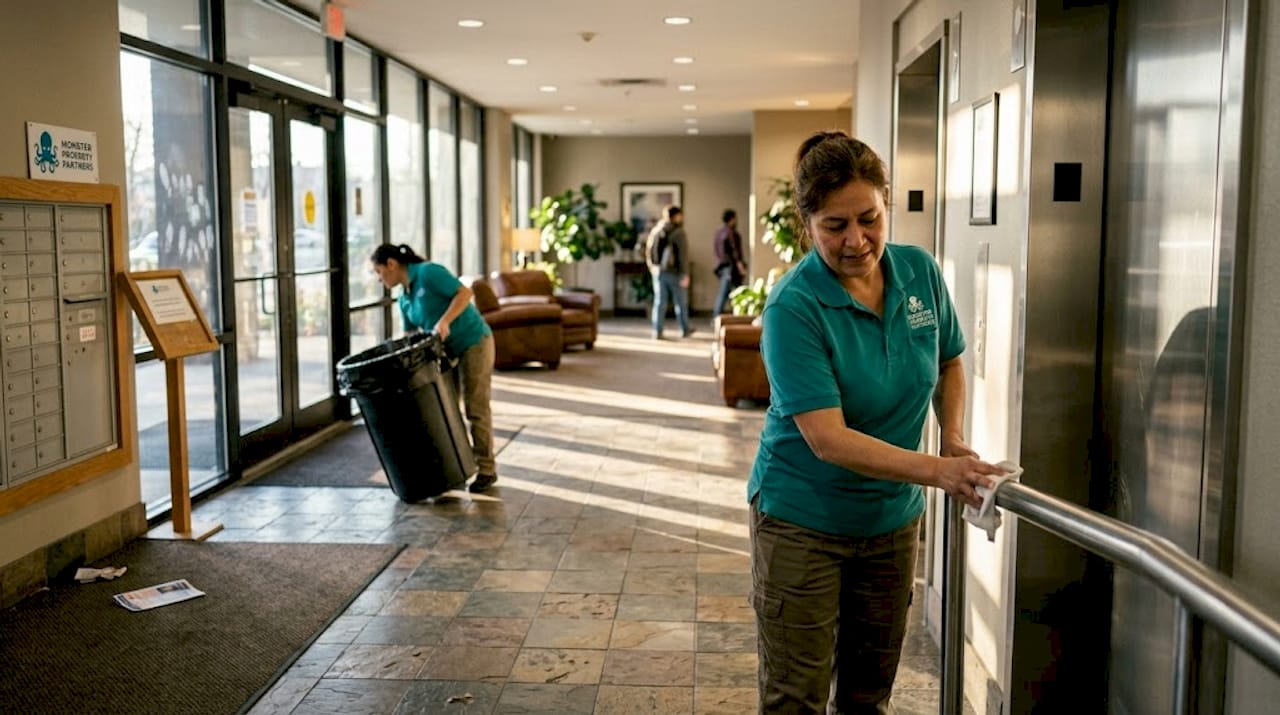
For staffing purposes, know your productivity benchmark. Standard commercial cleaning covers 2,000 to 3,000 square feet per hour in routine common area work. If your team is moving slower than that, the culprit is usually poor routing, wrong equipment, or too many interruptions.
Here is how frequency should break down by area:
- Lobbies: Daily cleaning is non-negotiable. This is your property's front door.
- Garbage and trash rooms: Daily. Odor, pests, and biohazard risk spike fast without it.
- Elevators: Daily wipe-down of buttons and surfaces; weekly deep clean of walls and floors.
- Hallways: Weekly for standard traffic; twice weekly near trash rooms or laundry areas.
- Stairwells: Weekly vacuuming and mopping; daily in high-traffic buildings.
- Laundry rooms: Daily lint trap clearing and surface wipe; weekly floor scrub.
High-traffic periods like summer move-in season, construction phases, or after community events require schedule adjustments. Build flexibility into your master schedule with a secondary crew or pre-approved overtime so surges do not break your baseline. Review property cleaning trends for data on how seasonal peaks affect labor demand in 2026.
For exterior common areas, concrete cleaning details matter as much as interior schedules. Walkways, parking decks, and dumpster pads collect grime fast and are often the first thing prospective residents notice on a property tour.
Troubleshooting workflow breakdowns and common mistakes
Even well-designed workflows break down. The difference between a reactive property and a proactive one is how fast managers identify the failure point and whether they close the loop to prevent it from repeating. A preventive approach to scheduling and workflow management consistently outperforms reactive emergency cleaning in both cost and resident satisfaction.
Here are the five most common workflow failure points:
- Missed checklists: Staff skip sign-offs during busy periods. Incomplete records mean no audit trail and no accountability.
- Routing errors: Cleaners double back across zones they already cleaned, wasting time and risking cross-contamination.
- Poor dwell time: Disinfectants need contact time to work, typically 30 to 60 seconds. Wiping immediately after application wastes product and misses sanitization.
- Skipped audits: Quality control only works if it happens consistently. Audit fatigue is real, and skipping one week tends to become two.
- Supply shortfalls: Running out of a key chemical mid-shift forces substitutions that may not meet your APPA level targets.
Legal and compliance risk is real. Incomplete cleaning records in health-regulated spaces like pools, gyms, and trash rooms can expose your property to liability. Document everything, every time.
Pro Tip: Create an incident log for recurring errors. Any failure that happens more than twice in a month goes into a written log and gets addressed in weekly team retraining. Patterns become visible fast when you track them.
Consistent cleaning standards drive renewals and tenant satisfaction at a measurable level. You can also reduce chemical spend and environmental impact significantly by reviewing your sustainable cleaning practices for multi-family properties.
A fresh perspective: Why your cleaning workflow never stays fixed
Here is something most workflow guides skip entirely: the process you build today will start breaking down within 90 days without active maintenance. Staff turnover, new product formulations, seasonal changes, and building renovations all create drift. The cleaning routine that worked in January may be genuinely inadequate by April.
The managers who get consistent results over years are not the ones with the best initial workflow. They are the ones who treat the workflow as a living document. They run surprise audits. They review the incident log weekly, not quarterly. They retrain when patterns emerge rather than waiting for a formal performance review.
The "set and forget" myth is the single biggest reason cleaning quality degrades in multi-family buildings over time. A system without a leader watching it will always revert to minimum effort. Review your manager's cleaning insights regularly and schedule a formal workflow review every quarter. That discipline is what separates properties that hold their reputation from those that lose it slowly.
Support for every stage of your apartment cleaning workflow
Building a reliable cleaning workflow is a significant operational lift, and even the best internal teams have gaps. That is where Monster Property Partners comes in.
Our team specializes in multifamily cleaning services designed for the specific demands of apartment buildings and multi-family communities. From high-traffic lobby maintenance to scheduled exterior work, we operate at scale without sacrificing quality. We also provide specialized common area cleaning solutions for concrete surfaces, dumpster pads, and walkways that internal teams often lack the equipment to handle. Reach out to discuss how we can fill gaps in your current workflow or reinforce your team during peak seasons.
Frequently asked questions
What is the optimal sequence for cleaning apartment buildings?
Start from the top and work downward, beginning with ceilings and light fixtures and finishing with floors and high-touch disinfection. Always move from clean zones to dirty zones to prevent cross-contamination.
How often should high-traffic areas like lobbies and garbage rooms be cleaned?
High-traffic lobbies and garbage rooms require daily cleaning to stay within acceptable standards and prevent resident complaints from escalating.
How do I benchmark cleanliness in my building?
Use APPA Custodial Standards, which define five levels from Level 1 (sterile) to Level 5 (unkempt). Most multi-family common areas target Level 2 or Level 3 depending on the zone.
What is a good productivity rate for my cleaning team?
For standard common areas, expect your team to cover 2,000 to 3,000 square feet per hour. Slower rates usually point to routing inefficiency or equipment problems.
Should I use manual checklists or cleaning automation?
Manual checklists work for small teams, but PMS automation tools reduce errors, provide real-time task tracking, and create a digital audit trail that manual systems simply cannot match at scale.