
TL;DR:
- Proper maintenance planning reduces costs and protects property value through preventive and predictive tasks.
- Routine interior, exterior, and seasonal maintenance are essential for tenant satisfaction and long-term asset health.
- Documented maintenance history enhances property value, appeals to buyers and lenders, and creates a competitive advantage.
Missed maintenance is one of the fastest ways to erode the value of a multi-family investment. Deferred maintenance costs 3 to 5 times more than preventive care, yet most owners only react after something breaks. Across apartment buildings and multi-family units, the sheer number of systems, tenants, and shared spaces makes it easy to lose track of what needs attention and when. This guide breaks down 16 essential property maintenance tasks organized by category, giving you a practical, repeatable framework to protect your investment, reduce emergency calls, and keep every unit performing at its best.
Table of Contents
- Maintenance planning and prevention: Your first line of defense
- Routine interior maintenance: Essential tasks for every unit
- Exterior and shared areas: High-impact property-wide upkeep
- Seasonal maintenance: Adapting for weather and local risks
- Our take: Why property maintenance is really an ownership strategy
- Advance your property's performance with expert help
- Frequently asked questions
Key Takeaways
| Point | Details |
|---|---|
| Preventive planning pays | Scheduling and budgeting regular maintenance prevents emergencies and reduces costs dramatically. |
| Interior and exterior tasks | Comprehensive upkeep includes both inside-unit routines and property-wide systems. |
| Tailor to seasons and age | Seasonal needs and building age must shape your annual maintenance checklist. |
| Proactive documentation | Maintaining detailed records helps with insurance claims and maximizes resale value. |
Maintenance planning and prevention: Your first line of defense
Before diving into the core maintenance tasks, it is critical to set up a structured maintenance plan. Without one, you are always reacting instead of leading, and reactive repairs are always more expensive.
There is a real difference between preventive and predictive maintenance. Preventive maintenance means completing tasks on a fixed schedule, like changing HVAC filters every 90 days, regardless of whether a problem has appeared. Predictive maintenance uses data from equipment sensors or inspection logs to anticipate failures before they happen. For most apartment building owners, a strong preventive system is the foundation, with predictive tools added as your portfolio grows.
A practical scheduling framework breaks tasks into four time horizons:
- Monthly: Inspect common areas, check fire safety equipment, review tenant repair requests for patterns.
- Quarterly: HVAC filter changes, plumbing leak checks, pest control walkthroughs.
- Semi-annual: Roof and gutter inspections, exterior pressure washing, smoke and CO detector testing.
- Annual: Full HVAC servicing, water heater flushing, electrical panel inspection, and full exterior assessment.
For budgeting, the maintenance planning benchmark most professionals use is 1 to 2% of your property's value annually. On a $2 million building, that is $20,000 to $40,000 per year before any major capital improvements. Preventive maintenance saves up to 60% on HVAC emergencies alone, which justifies the upfront spend many times over.
One finding that surprises many owners: maintenance costs vary more by building characteristics like age, construction type, and system complexity than by tenant behavior. That means your budget should reflect your property's specific profile, not just an industry average.
Pro Tip: Keep a digital maintenance log for every unit and shared system. Insurance carriers and future buyers will pay a premium for buildings with documented maintenance histories. Good records can also support faster claims processing after weather events.
Your documentation practice is as important as the maintenance itself. Good upkeep tips consistently point to organized records as one of the highest-leverage habits a property owner can build.
Routine interior maintenance: Essential tasks for every unit
With the right plan in place, you can now focus on recurring interior tasks that keep every unit safe and habitable. These are the tasks that directly affect tenant satisfaction and your legal compliance as a landlord.
Here are the core interior tasks every multi-family property needs:
- HVAC filters and coils: Change filters every 60 to 90 days. Annual coil cleaning and refrigerant inspection prevent costly breakdowns in peak summer heat.
- Plumbing leak detection: Check under sinks, around toilets, and at water heater connections quarterly. Small leaks cause major mold and structural damage when missed.
- Water heater maintenance: Flush sediment annually and inspect the anode rod. A neglected water heater fails faster and uses more energy.
- Caulking and sealing: Inspect bathroom and kitchen caulk annually. Cracked caulk leads to water intrusion and expensive subfloor repairs.
- Smoke and CO detectors: Test monthly and replace batteries semi-annually. Replace the units themselves every 10 years.
- GFCI outlet testing: Test all ground fault circuit interrupter outlets quarterly, especially in bathrooms, kitchens, and laundry rooms.
- Fire extinguisher checks: Inspect monthly and schedule annual professional service.
- Pest control: Treat quarterly as a preventive measure rather than waiting for infestations to appear.
Annual HVAC inspections and filter changes, plumbing checks, leak detection, and water heater flushing are consistently ranked as the most critical recurring interior tasks across all property types.
Pro Tip: Consider making air filter changes and battery replacements a shared responsibility. Provide tenants with filters and batteries at move-in and each lease renewal. This reduces your cost and keeps tenants engaged in the property's care.
A detailed interior cleaning checklist specific to multi-family units can help your team stay consistent across all floors and buildings within your portfolio.
Exterior and shared areas: High-impact property-wide upkeep
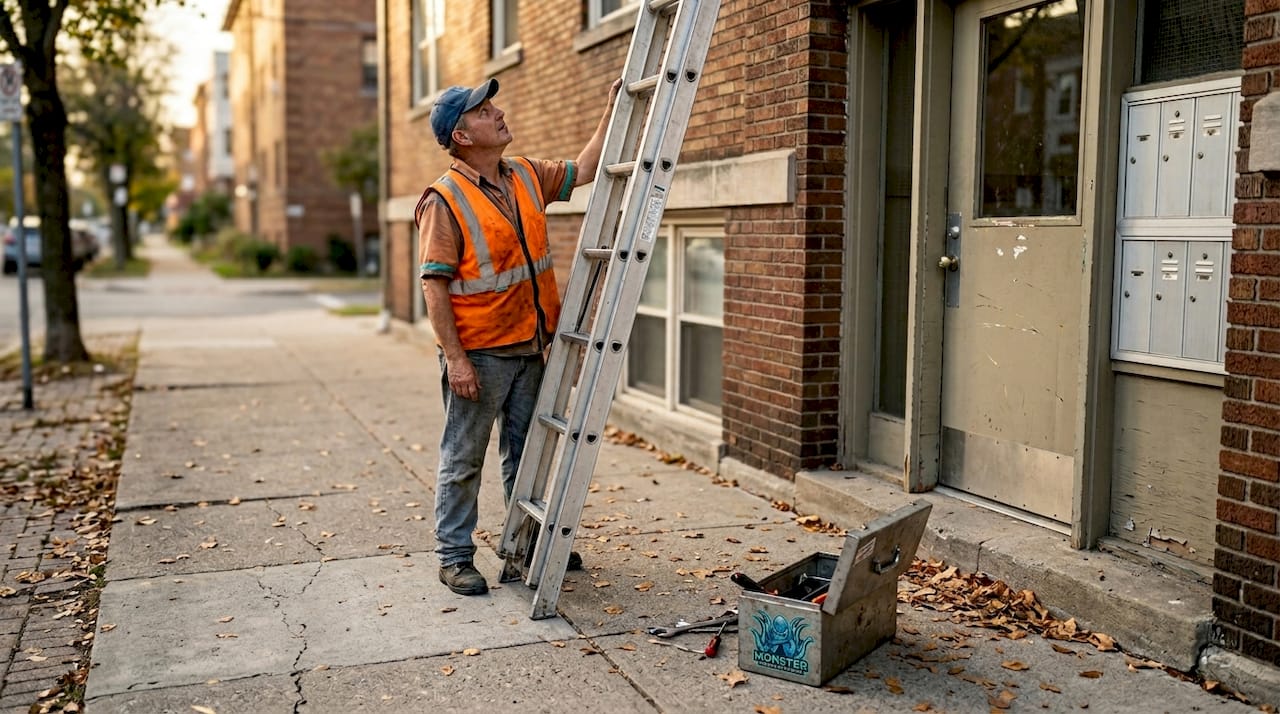
Interior work is matched in importance by what happens outside and in shared spaces. Exterior neglect is visible to every tenant, prospective renter, and lender who visits the property.
| Exterior task | Recommended frequency | Notes |
|---|---|---|
| Roof inspection | Semi-annual | Check after major storms |
| Gutter cleaning | Twice yearly | Spring and fall minimum |
| Facade and siding check | Annual | Look for cracks, staining, and rust |
| Parking lot and sidewalks | Quarterly visual, annual seal | Watch for trip hazards |
| Elevator inspection | Per local code (often annual) | Licensed inspection required |
| Security system check | Quarterly | Camera functionality, lighting |
| Landscaping and grounds | Monthly to weekly | Seasonal adjustments |
| Common area cleaning | Weekly to monthly | Lobbies, hallways, laundry rooms |
Shared systems like elevators or central HVAC add real complexity to multi-family maintenance and require structured, scheduled attention rather than ad hoc responses.
Exterior maintenance costs fall within a well-established range. Budget from $900 to $2,200 per unit annually for exterior upkeep, with older buildings and those in harsh climates landing at the higher end.
Deferred exterior maintenance is the number one issue flagged during property appraisals. Cracked sidewalks, peeling paint, and clogged gutters tell lenders and buyers that the property has been neglected from the inside out.
For owners building out their exterior program, a structured exterior checklist keeps your team consistent across every inspection cycle. And for buildings with more complex facade systems, a detailed building exterior checklist covering all seven key steps is worth following closely.
Seasonal maintenance: Adapting for weather and local risks
No maintenance plan is complete without adapting tasks to the calendar and your climate. Each season introduces new demands, and missing a seasonal window often creates a problem that lasts all year.
Here is a season-by-season breakdown:
| Season | Key tasks |
|---|---|
| Spring | Gutter cleaning, AC startup service, pressure washing, roof check after winter |
| Summer | Landscaping, pool maintenance, pest control surge, parking lot sealcoating |
| Fall | Gutter cleaning, furnace service, weatherstripping, roof prep before winter |
| Winter | Pipe winterization, snow removal planning, heating system monitoring |
Spring, summer, fall, and winter each carry distinct maintenance priorities, and both older buildings and colder climates require tailored approaches rather than a generic schedule.
Here are four seasonal adjustments that matter most:
- Add 10% per decade for building age. A 30-year-old building needs roughly 30% more maintenance attention than a new one of the same size.
- Cold climates need bi-annual HVAC servicing. One service in spring for cooling, one in fall for heating. Single-service programs leave you exposed.
- Pressure washing is a spring and fall essential. Mold, algae, and road salt build up over months and degrade surfaces faster when left untreated.
- Document every completed seasonal task. Use photos and timestamps. This protects you legally and helps future property managers hit the ground running.
Pressure washing in particular is one of the most impactful and underrated seasonal tasks. Our seasonal exterior cleaning guide breaks down exactly what to target each quarter, and our piece on seasonal cleanings for multi-family properties goes deeper on timing and scope. If you want the full case for why this matters, read more about pressure washing as a multi-family essential.
Our take: Why property maintenance is really an ownership strategy
Now that you have seen the key tasks, it is worth reconsidering how maintenance fits within your overall investment strategy. Most owners treat maintenance as an unavoidable expense. The ones who outperform the market treat it as a competitive advantage.
Here is what that looks like in practice. A property with documented, consistent maintenance commands higher rents, retains tenants longer, and sells at a premium. Buyers and lenders do not just look at current condition; they look at maintenance history as a proxy for ownership quality. That log you keep is actually building equity.
The biggest mistake we see is owners delegating everything to tenants or relying on technology without on-site verification. Apps and portals are useful tools, but they do not replace a trained eye walking the property. Sensors miss what a hands-on inspection catches.
The most overlooked task in every portfolio? Consistent documentation. Following strong maintenance strategy tips on documentation alone can meaningfully change what you net at resale. Treat every maintenance record as a long-term asset, because it is.
Advance your property's performance with expert help
If stepping up your maintenance program sounds daunting, expert help can simplify the process and boost your property's appeal. There are tasks that require specialized equipment, commercial-grade products, and trained crews to do them right at scale.
At Monster Property Partners, we work directly with apartment building owners and property managers to handle the exterior and common area work that is hard to manage in-house. From large-scale pressure washing to concrete cleaning in parking lots, breezeways, and pool decks, we bring the consistency that multi-family properties need. Explore our full range of multifamily maintenance services and see how a consistent professional partnership keeps your property performing at its highest level year-round.
Frequently asked questions
What is the most important routine property maintenance task?
Annual HVAC inspections and regular filter changes are considered the most critical routine task, since HVAC failures are among the most expensive and disruptive emergencies a multi-family property owner faces.
How often should gutters be cleaned in multi-family buildings?
Gutters should be cleaned at least twice a year, with spring and fall being the ideal windows to clear debris and ensure drainage systems are ready for heavy rain and freezing temperatures.
What is the recommended maintenance budget for apartment owners?
Most professionals recommend setting aside 1 to 2% of your property's value each year, which typically works out to $900 to $2,200 per unit annually depending on building age and location.
Does building age affect which maintenance tasks are needed?
Yes, significantly. Older buildings require more frequent inspections and a budget increase of roughly 10% per decade, since aging systems and materials fail faster and need closer monitoring.