
TL;DR:
- Proper pressure washing compliance requires containment of runoff, adherence to EPA regulations, and careful management of lead paint and chemical use. It is essential for property managers to document procedures thoroughly, manage site-specific challenges, and understand that compliance enhances property value and tenant perception. Partnering with specialized providers ensures consistent, legal, and environmentally responsible exterior cleaning practices.
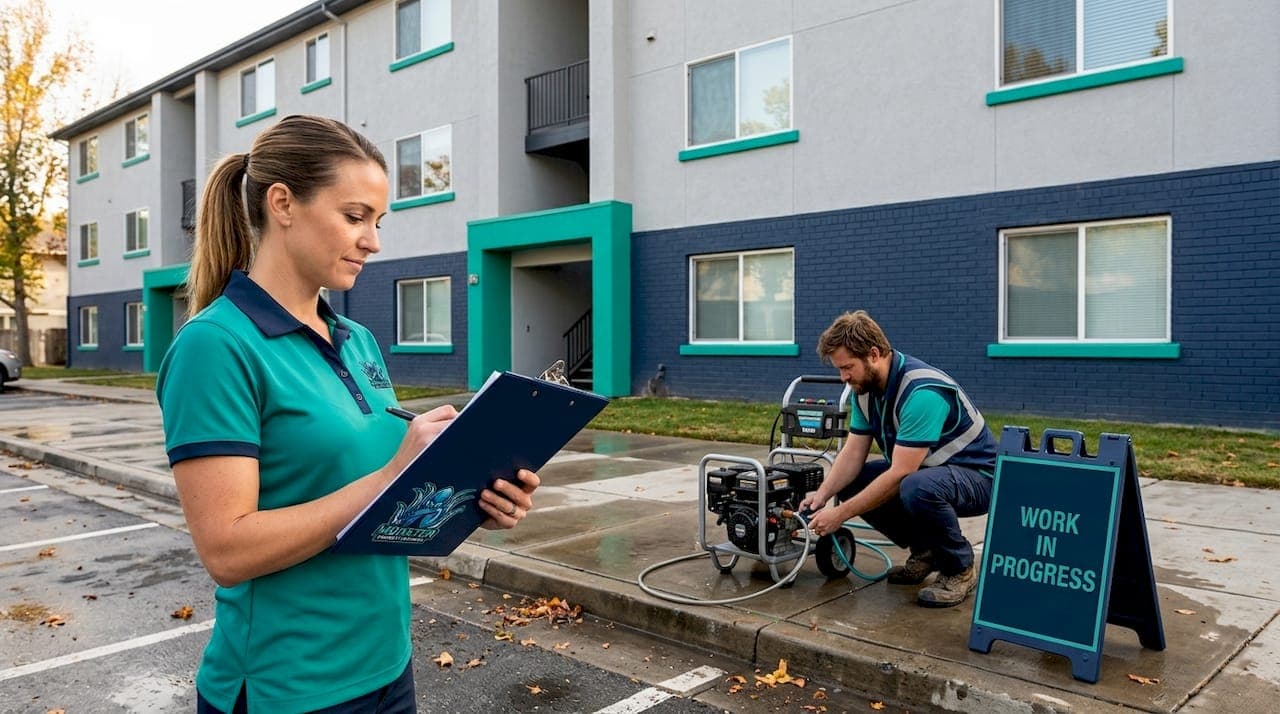
Pressure washing looks straightforward on the surface. You point, you spray, the grime disappears. But property managers who treat exterior cleaning as a simple maintenance task are leaving their communities exposed to EPA fines, stormwater violations, and even tenant lawsuits. The reality is that pressure washing compliance in multi-family housing sits at the intersection of federal environmental law, local municipal codes, and building-specific hazards. This article breaks down exactly what you need to know, from wastewater containment to lead paint rules, so your team can clean with confidence and zero legal exposure.
Table of Contents
- Understanding pressure washing compliance
- Core EPA regulations and the RRP Rule explained
- Managing edge cases and site-specific compliance challenges
- Steps to ensure and document compliance
- A new mindset: Why compliance is your competitive advantage
- Partnering for seamless compliance: How Monster Property Partners can help
- Frequently asked questions
Key Takeaways
| Point | Details |
|---|---|
| Environmental laws are strict | Pressure washing for multi-family housing must meet EPA and Clean Water Act rules to avoid fines. |
| Containment is non-negotiable | Wastewater and debris must be properly contained and disposed of during all cleaning operations. |
| Document everything | Keeping records of prep, methods, and disposal can protect you if compliance is questioned. |
| Know your edge cases | High-risk zones and surfaces require extra care and full recovery to pass inspections. |
| Routine compliance is a win | A proactive compliance mindset not only prevents penalties but attracts better tenants and owners. |
Understanding pressure washing compliance
Pressure washing compliance is not a single rule. It is a layered set of requirements that varies by property age, location, surface type, and the chemicals involved. For property managers overseeing apartment communities, two federal frameworks dominate: the Clean Water Act and the National Pollutant Discharge Elimination System, commonly called NPDES. Both govern what happens to the water after it hits the ground.
Here is why this matters practically. When you pressure wash a parking garage, walkway, or building exterior, the runoff picks up oils, detergents, heavy metals, and biological waste. That contaminated water has to go somewhere. In most cases, it wants to flow directly into the nearest storm drain, which connects straight to local waterways. Federal law treats that as an illegal discharge, and environmental regulations under the Clean Water Act and NPDES stormwater program require containment and proper disposal to prevent exactly that from happening.
"Pressure washing compliance for multi-family housing primarily involves environmental regulations under the Clean Water Act and NPDES stormwater program, requiring containment and proper disposal of wastewater to prevent illegal discharges into storm drains." — U.S. Environmental Protection Agency
The core concept here is wastewater containment, which means capturing runoff before it reaches a storm drain and disposing of it through an approved sanitary sewer or licensed hauler. Many operators skip this step because it adds cost and setup time. That shortcut can result in fines that dwarf the savings. Before you schedule your next cleaning cycle, review your pressure washing preparation guide to verify your containment setup is adequate.
| Compliance area | Governing authority | Key requirement |
|---|---|---|
| Wastewater discharge | EPA, NPDES | Contain runoff, no storm drain discharge |
| Lead paint disturbance | EPA RRP Rule | Isolation, containment, certified firm |
| Chemical use | State/local EPA | Approved detergents, MSDS documentation |
| Noise levels | HOA, local code | Equipment under 75dB during restricted hours |
| Water use permits | Municipal water authority | May require metered commercial permit |
Compliance also extends to detergent selection. Not every cleaning solution is legal for discharge into a sanitary sewer, and some municipalities require pre-approval for commercial surfactants. Read your commercial guide for managers for a full breakdown of chemical requirements by project type. The industry standards for exterior cleaning provide the professional benchmarks your vendors should already be meeting.
Core EPA regulations and the RRP Rule explained
Two EPA frameworks come up most often in multi-family pressure washing, and understanding both protects you from the most serious violations.
The Clean Water Act established the NPDES permit program, which controls how pollutants enter U.S. waterways. For property managers, the practical impact is this: any pressure washing that generates runoff with detergents, oils, or debris must be contained. Period. Municipal storm drains are not an approved disposal route. Violating this can result in fines that reach tens of thousands of dollars per incident under 33 U.S.C. § 1251.
The EPA's Renovation, Repair, and Painting Rule (RRP Rule) is the second major framework. It applies specifically to properties built before 1978, which is the year the federal government banned lead-based paint in residential housing. If your pressure washing activities disturb surfaces coated with lead paint, the RRP Rule kicks in. This means the work area must be isolated, containment measures must prevent dust and debris from escaping, and wastewater must be disposed of properly. Critically, the firm performing the work must be EPA-certified under the RRP program.
Here is a numbered action plan for bringing a pre-1978 property into compliance before any washing begins:
- Identify surface age and paint condition. Pull building records and inspect exteriors for chalking, flaking, or peeling paint.
- Test for lead. Use an EPA-recognized test kit or hire a certified inspector. Do not assume.
- Select a certified contractor. Verify the firm holds an EPA RRP certification before signing any agreement.
- Establish containment zones. Plastic sheeting, berms, and wet-vac recovery systems must be in place before water flows.
- Document all preparation steps. Photographs, inspection reports, and contractor certifications go into your compliance file.
- Arrange wastewater disposal. Confirm the collected water will go to an approved sanitary sewer or a licensed waste hauler.
- Conduct post-work clearance. Verify no lead-contaminated debris remains in common areas or near HVAC intakes.
Pro Tip: Always test surfaces on buildings older than 1978 for lead before scheduling any exterior washing. A basic XRF test or swab kit costs far less than an RRP violation, which can reach $37,500 per day under EPA enforcement.
If your property uses soft washing methods instead of high-pressure equipment, you still need containment. Lower pressure does not exempt you from wastewater rules. What soft washing does offer is reduced risk of physically disturbing lead paint surfaces, which lowers your RRP exposure when properly managed.
Managing edge cases and site-specific compliance challenges
General compliance rules cover the basics. But multi-family properties contain zones and surfaces that create unique legal and environmental risks, and your cleaning program needs to account for each one specifically.
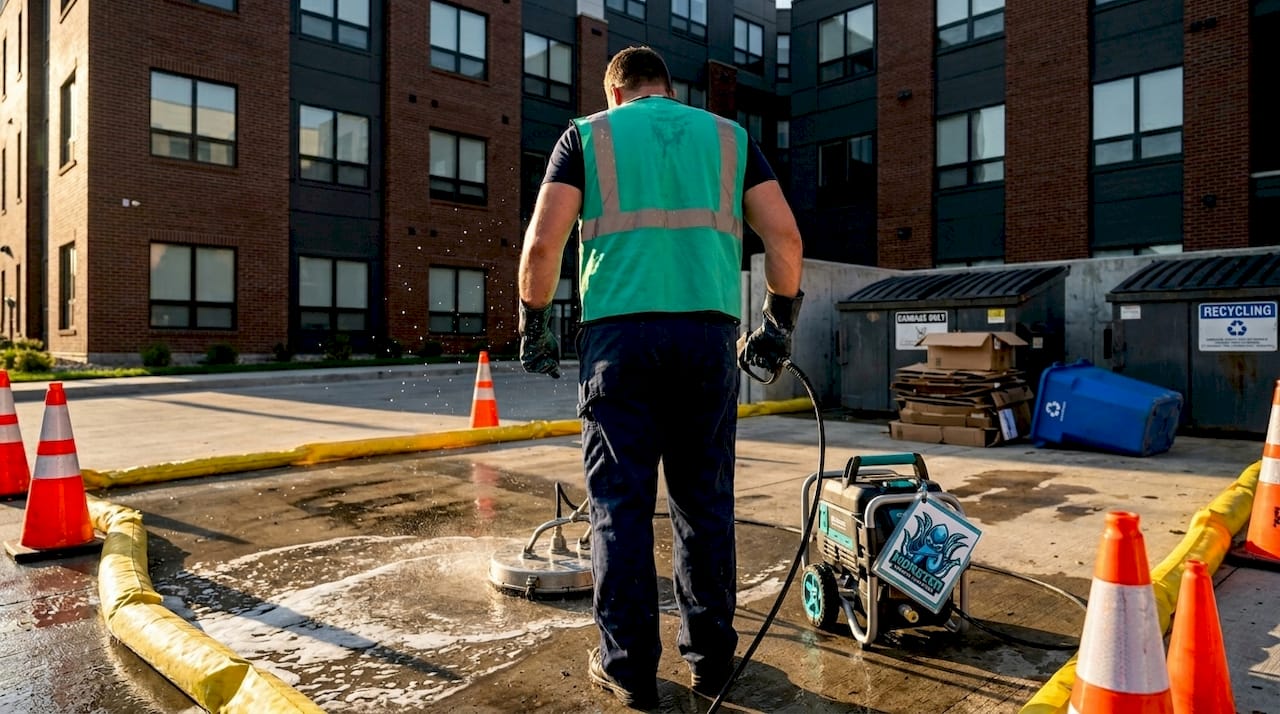
High-contamination zones like dumpster pads, loading docks, and parking lots are the most hazardous from a wastewater perspective. These areas accumulate oils, grease, tire chemicals, and biological waste at concentrations that require full recovery, meaning every drop of rinse water must be captured and disposed of properly. Partial containment is not sufficient here. Budget for berms, vacuum recovery trucks, or roll-off containment units when scheduling these jobs.
Sensitive surfaces present a different challenge. Soft washing is preferred over high-pressure methods for stucco, EIFS (Exterior Insulation Finishing System), vinyl siding, and aged concrete. High-pressure washing on these materials can force water behind panels, crack coatings, and void manufacturer warranties, all of which create liability that property owners absorb directly. The table below compares the two approaches.
| Factor | High-pressure washing | Soft washing |
|---|---|---|
| PSI range | 2,000 to 4,000+ PSI | 100 to 500 PSI |
| Chemical reliance | Low | Higher (biodegradable) |
| Surface damage risk | Elevated on soft/aged materials | Low |
| RRP paint disturbance risk | High on older buildings | Lower, but containment still required |
| Noise output | Higher | Lower |
| Best use | Concrete, masonry, hard surfaces | Stucco, vinyl, wood, rooflines |
HOA and community noise compliance is another edge case that catches operators off guard. Many communities have specific quiet hours, typically before 7 a.m. and after 8 p.m. on weekdays, and more restrictive windows on weekends. Electric pressure washers rated under 75dB are the safest choice for communities with strict HOA rules, as they stay comfortably within most noise ordinances.
Here is a practical checklist for minimizing neighborhood and HOA disruptions:
- Schedule all pressure washing during approved working hours per your HOA or local noise ordinance
- Notify residents at least 48 hours in advance via door hangers or community portal
- Use equipment rated under 75dB whenever possible, especially in dense residential settings
- Block off the work area with cones and signage to prevent pedestrian interference
- Assign a site contact who can field resident questions or concerns in real time
- Avoid washing near open windows, HVAC intakes, or laundry vents
Review your pressure washing checklist to confirm you have covered every site-specific variable before work begins.
Pro Tip: Document every edge case cleaning with before and after photos, timestamped and stored in your property management system. If an HOA dispute or environmental complaint ever arises, visual proof of proper containment and clean results is your strongest defense.
Steps to ensure and document compliance
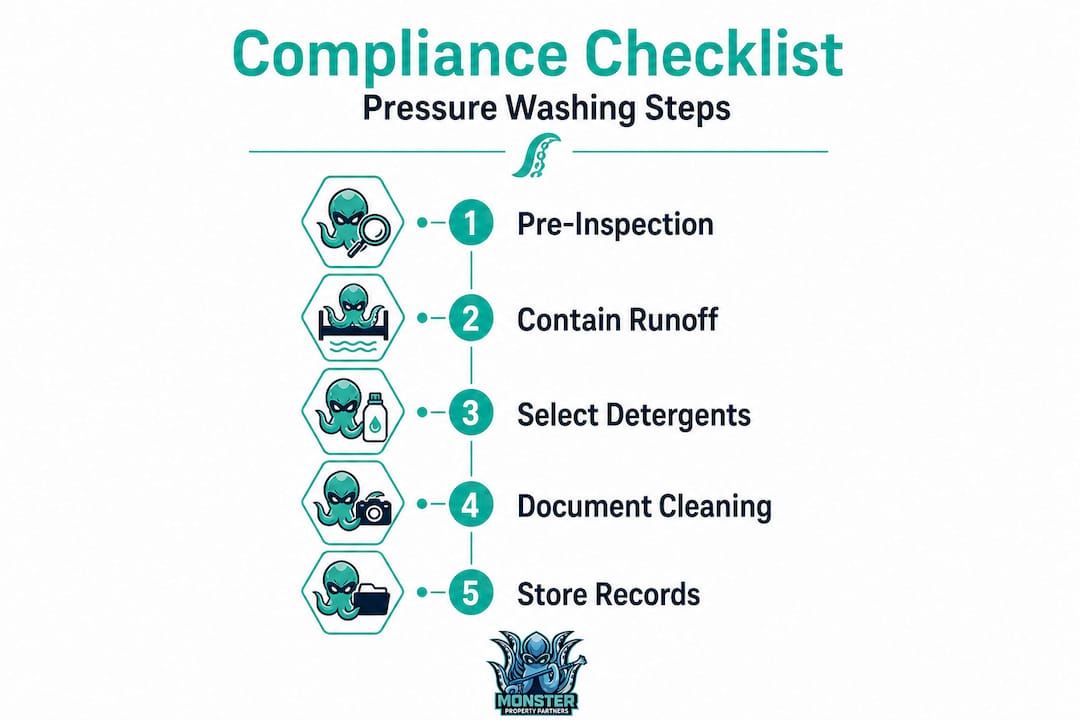
A solid compliance framework is not just a day-of checklist. It is a repeatable system that your team can execute consistently across every property in your portfolio. Here is a numbered action plan that addresses the full lifecycle of a compliant pressure washing job.
- Pre-inspection. Walk the property and identify all surfaces, drainage paths, and high-contamination zones. Note any surfaces that require RRP evaluation.
- Choose the proper method. Match your equipment and technique to the surface type and contamination level. Use the comparison table from the previous section as your guide.
- Set up wastewater containment. Install berms, plugs, or vacuum recovery systems at all drainage points before any water flows. Verify storm drains are blocked per NPDES requirements.
- Execute the cleaning. Work systematically from the highest point to the lowest, controlling runoff direction as you go.
- Collect and verify disposal. Transfer captured wastewater to an approved sanitary sewer connection or arrange pickup by a licensed waste hauler. Get a receipt or manifest for your records.
- Document completion. Photograph the finished area, record the volume of wastewater disposed, and note any incidents or deviations from the plan.
- File records. Store all documentation in your property management system for a minimum of three years. Some states require longer retention.
If a spill or containment failure occurs mid-job, your team needs a clear emergency response:
- Stop work immediately and contain the spread using additional berms or absorbent materials
- Photograph the spill location, time, and extent before any cleanup begins
- Notify your environmental compliance contact and review whether a regulatory report is required
- Clean up the affected area using approved methods and document all steps taken
- Update your site risk assessment to prevent recurrence on future jobs
Routine documentation does more than satisfy regulators. It creates an audit trail that protects your property during insurance claims, tenant disputes, and contract renewals with vendors. Your maintenance manager pro tips resource covers documentation templates that slot directly into most property management platforms. If you have not yet built a routine cleaning schedule around compliance checkpoints, that is the fastest way to convert one-off compliance efforts into a sustainable, repeatable system.
A new mindset: Why compliance is your competitive advantage
Most property managers treat compliance as overhead, a cost center that slows down operations and adds paperwork. We see it completely differently, and the data backs us up.
Here is the uncomfortable truth: property managers who invest in documented, repeatable compliance programs are building a financial asset, not just avoiding fines. When a prospective institutional buyer or REIT evaluates a multi-family property, exterior maintenance records are part of due diligence. A clean compliance history signals operational discipline, reduced deferred maintenance, and lower environmental liability risk. Properties with that profile close faster and at stronger valuations.
There is also a leasing angle that most operators miss entirely. Quality tenants, the kind who renew leases and pay on time, make their housing decisions partly based on how well a community is maintained. Stained walkways, moldy breezeways, and neglected dumpster areas communicate something very specific about how management runs the property. Consistent, compliant exterior cleaning is not just curb appeal. It is a message to your residents about the standard of care they can expect.
We have seen properties cut their annual maintenance liability exposure significantly by simply shifting from reactive cleaning to a documented, compliance-first exterior program. When your impact on property value is tied directly to how clean and well-maintained the exterior looks, compliance stops being a burden and starts being a strategy. The property managers winning in competitive rental markets are not waiting for a violation to motivate change. They are using compliance documentation as a marketing asset and a negotiating tool.
Partnering for seamless compliance: How Monster Property Partners can help
Navigating the Clean Water Act, the RRP Rule, local noise ordinances, and surface-specific washing protocols is a significant operational lift for any property management team.
At Monster Property Partners, we built our entire service model around eliminating that burden for you. Our crews arrive with compliant containment systems, EPA-aware protocols, and the documentation workflow your team needs to maintain a clean compliance record. From stormwater containment on parking deck washes to RRP-compliant preparation on pre-1978 buildings, we handle the complexity so you can focus on your residents. Explore our full range of multifamily exterior cleaning services or learn about our specialized common area concrete cleaning programs designed specifically for high-traffic apartment communities. Let us make compliance your competitive edge, not your operational headache.
Frequently asked questions
What is the biggest compliance risk in pressure washing for multi-family housing?
The top risk is unlawful discharge into storm drains, which triggers EPA enforcement under the Clean Water Act and can result in fines reaching tens of thousands of dollars per incident.
Does the RRP Rule apply to all multi-family properties?
No, the RRP Rule applies specifically when washing may disturb lead-based paint, which is primarily a concern for properties built before 1978. Newer construction falls outside its scope.
How can property managers avoid noise complaints during exterior cleaning?
Schedule work during locally approved hours and use electric equipment rated under 75dB to stay within most HOA and municipal noise ordinances. Advance notice to residents also significantly reduces complaint volume.
What records or documentation should be kept after pressure washing?
Keep timestamped photos, wastewater disposal receipts, contractor certifications, and any incident reports to demonstrate NPDES compliance and reduce liability exposure during inspections or disputes. Most attorneys recommend a minimum three-year retention period.