
TL;DR:
- Professional pressure washing uses specialized equipment and strict wastewater management to prevent legal violations.
- Regular external cleaning boosts property value, tenant satisfaction, and reduces long-term repair costs.
- Proper vendor selection, ongoing compliance, and clear contracts are essential to avoid fines and damage.
Commercial Pressure Washing Guide for Property Managers
Many property managers assume a basic rinse or hose-down keeps their building looking fine. It doesn't. Large apartment complexes and multi-family units accumulate mold, oil stains, algae, and grime at a rate that standard cleaning simply cannot address. More critically, improper cleaning can violate federal environmental law, exposing your property to fines and liability. Understanding what commercial pressure washing actually involves, what it delivers, and how to stay compliant is essential knowledge for any property manager serious about protecting their asset and their residents.
Table of Contents
- What commercial pressure washing involves
- Key benefits for property managers
- Key regulations and compliance concerns
- How to select the right commercial pressure washing service
- What most property managers miss about pressure washing
- Keep your property clean, safe, and compliant with expert help
- Frequently asked questions
Key Takeaways
| Point | Details |
|---|---|
| Better curb appeal | Professional pressure washing makes properties more attractive and keeps tenants happy. |
| Compliance is critical | Following federal and state water disposal rules avoids costly fines and legal troubles. |
| Save on long-term costs | Routine pressure washing prevents expensive repairs and preserves property value. |
| Choose pros carefully | Hiring experienced, compliant vendors is the key to effective, risk-free exterior cleaning. |
What commercial pressure washing involves
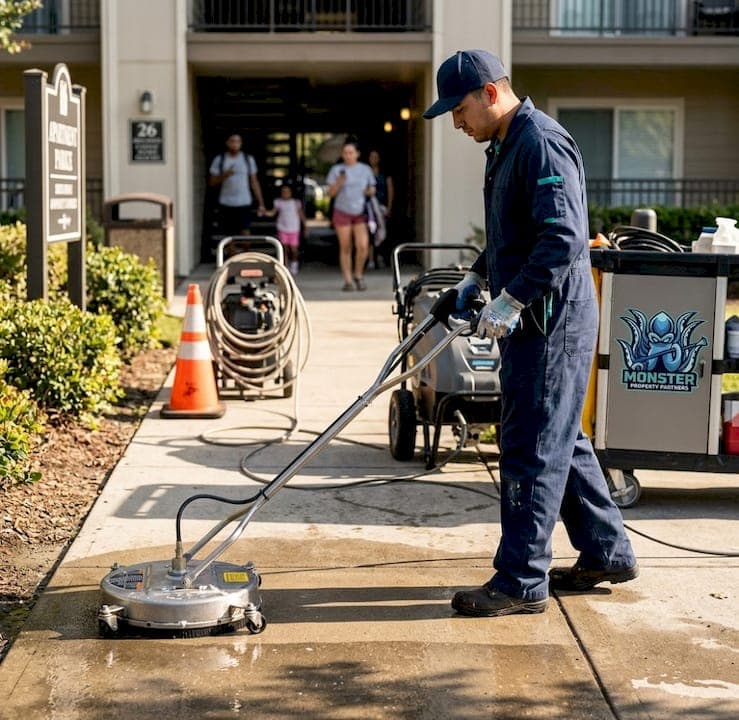
Commercial pressure washing is not the same as renting a machine from a hardware store on a Saturday afternoon. At the professional level, it involves high-capacity hot and cold water pressure systems, specialized surface cleaners, chemical application (called soft washing when used on delicate surfaces), and purpose-built recovery equipment. The scale, power, and regulatory requirements are in a completely different category from anything residential.
For apartment buildings and multi-family properties, the scope typically covers:
- Building exteriors and siding (vinyl, stucco, brick, EIFS)
- Parking lots, garages, and driveways (oil stains, tire marks, gum)
- Walkways, breezeways, and stairwells
- Dumpster pads and trash enclosures
- Pool decks, recreational areas, and common spaces
- Retaining walls and perimeter fencing
Each surface type requires a different pressure setting, nozzle angle, and chemical combination. Using too much pressure on stucco or older brick can cause permanent surface damage. Using too little on a grease-saturated dumpster pad will leave contamination behind. Professional crews understand the pressure washing systems required for each situation, and they dial in their approach before touching your building.
One area that surprises many property managers is wastewater management. When you pressure wash a parking lot or building exterior, the runoff carries oils, detergents, heavy metals, and biological contaminants. That water has to go somewhere, and where it goes matters legally. The Clean Water Act and NPDES (National Pollutant Discharge Elimination System) prohibit untreated wastewater from entering storm drains. Professional services use berms, containment mats, and vacuum recovery systems to capture and dispose of wastewater properly.
Pro Tip: Before booking any vendor, ask specifically how they handle wastewater recovery. If they look confused or say it drains "naturally," that's a serious red flag.
Familiarizing yourself with pressure washing terminology like PSI, GPM, dwell time, and downstream injection will also help you communicate more effectively with vendors and evaluate bids accurately. Understanding these terms means you can spot when a contractor is cutting corners or overselling equipment that doesn't fit your property. The benefits of professional pressure washing go well beyond appearance, and knowing the process helps you capture all of them.
Key benefits for property managers
Property managers operate under constant pressure to balance costs, maintain occupancy rates, and keep residents satisfied. Commercial pressure washing touches all three of those levers directly.
Curb appeal and property value
A clean building signals to prospective tenants that the property is well managed. Stained walkways, grimy siding, and mold-covered breezeways create the opposite impression. Studies consistently show that curb appeal significantly impacts perceived property value and lease-up rates. When competing properties in your market look sharp, you cannot afford to let exterior grime undercut your leasing team's efforts.
Tenant retention and satisfaction
Existing residents notice when common areas are cleaned regularly. It communicates respect for their living environment. Properties that invest in routine maintenance see measurable improvements in renewal rates. You can boost resident satisfaction significantly by scheduling consistent exterior cleanings, especially before peak leasing seasons in spring and summer.
Lower repair and maintenance costs
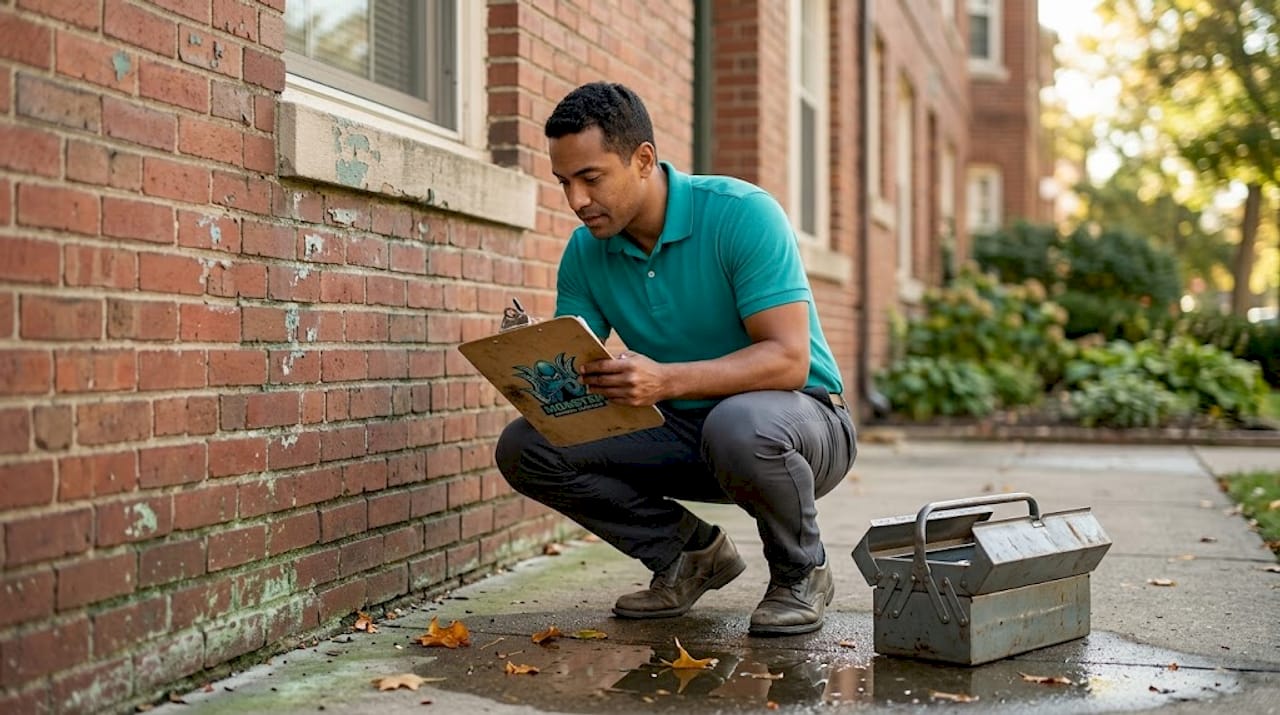
Mold, algae, and biological growth are not just cosmetic problems. Left untreated, they degrade surfaces over time. Algae on concrete walkways accelerates cracking. Mold on wood trim speeds up rot. Regular cleaning prevents this kind of structural deterioration. According to industry maintenance data, properties that pressure wash regularly can save on repair costs by up to 30% compared to those that don't.
| Benefit | Without regular washing | With regular washing |
|---|---|---|
| Surface lifespan | Degrades 30-40% faster | Extended significantly |
| Tenant complaints | Higher frequency | Noticeably lower |
| Repair costs | Escalates over time | Reduced long-term |
| Regulatory exposure | High risk | Managed and minimized |
| Curb appeal score | Below market average | Competitive or above |
Avoiding regulatory fines
This point deserves its own emphasis. The NPDES wastewater requirements are not optional, and enforcement does happen. If a contractor you hire allows contaminated runoff to reach a storm drain on your property, you as the property owner or manager may share liability. Proper compliance requires containment systems, vacuum recovery, and certified disposal.
Pro Tip: Include a wastewater compliance clause in every pressure washing vendor contract. If the vendor is cited, you want documentation proving your expectations were clearly communicated and agreed upon.
Key regulations and compliance concerns
Understanding the value is important, but following regulations is non-negotiable. Here's what you need to know as a property manager responsible for exterior cleaning decisions.
The Clean Water Act is the foundational federal law that governs water pollution in the United States. Under its framework, the NPDES program regulates point-source discharges, which includes the runoff generated during commercial pressure washing. In plain terms: wastewater from pressure washing cannot flow untreated into a storm drain, retention pond, or any waterway.
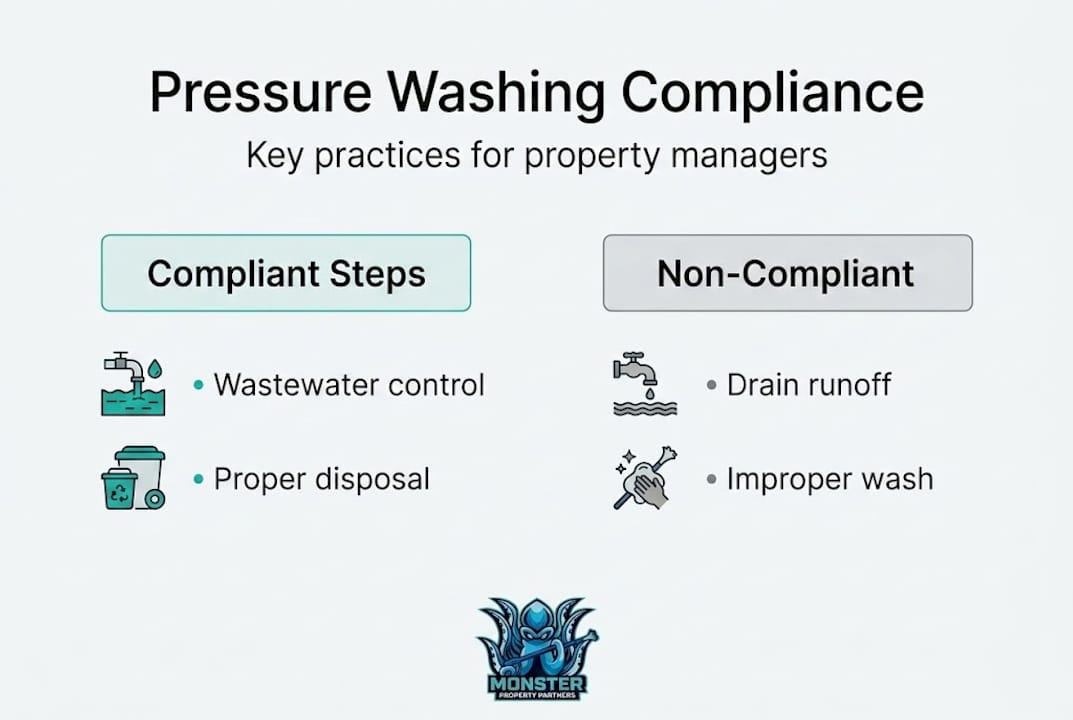
Here's how compliant versus non-compliant practices break down:
| Practice | Compliant | Non-Compliant |
|---|---|---|
| Wastewater containment | Berms and containment mats used | Water flows freely to drains |
| Recovery method | Vacuum recovery system deployed | No recovery system used |
| Disposal | Transported to approved facility | Dumped or left to drain |
| Documentation | Waste manifest maintained | No records kept |
| Contractor training | Certified, knowledgeable crew | Untrained, price-driven labor |
Consequences for getting this wrong are real. Fines under the Clean Water Act can reach into the tens of thousands of dollars per violation, per day. Beyond fines, there is reputational damage, potential legal action from neighboring properties or municipalities, and in serious cases, remediation orders that force you to fund cleanup operations.
Here are the best practices property managers should require from every vendor:
- Deploy containment berms around all drains before washing begins
- Use vacuum recovery systems rated for the volume of water being applied
- Apply only approved, biodegradable cleaning agents appropriate for the surface type
- Document all wastewater disposal with a written record for every job
- Verify the disposal site accepts pressure washing wastewater and is permitted to do so
"Regulations under the Clean Water Act and NPDES prohibit untreated wastewater discharge to storm drains. Compliance requires containment, vacuum recovery, berms, and proper disposal, and violations can lead to significant fines." Source
Building a routine pressure washing schedule around compliance checkpoints ensures you are never caught off guard by an inspection. Many property managers also find it helpful to review a maintenance manager guide to build internal protocols that hold vendors accountable on every visit.
Compliance is not a one-time event. It is a process you manage with each cleaning cycle, and the vendor you choose either supports that process or threatens it.
How to select the right commercial pressure washing service
Once you're aware of regulations, the next step is finding a service provider you can trust to do things right. The market is full of contractors who own a pressure washer and a pickup truck. Separating them from professional, compliant vendors requires asking the right questions upfront.
Start with this vendor selection checklist:
- Proof of general liability insurance (minimum $1 million per occurrence for commercial work)
- Workers' compensation coverage for all crew members on your property
- NPDES compliance documentation and written wastewater disposal process
- References from comparable properties (multi-family or large commercial, not residential)
- Written scope of work that specifies surfaces, methods, chemicals, and containment plan
- Equipment list showing professional-grade machines, not consumer-grade units
- Experience with your property's specific surface types (stucco, concrete, brick, etc.)
Ask vendors these specific questions before signing anything:
- How do you contain and dispose of wastewater on a job this size?
- What chemicals do you use, and are they approved for use near landscaping and drainage?
- Do you carry a written wastewater manifest for each job?
- Have you worked on properties with similar surface types and square footage?
- What happens if damage occurs to a surface during cleaning?
Red flags to watch for:
- Unusually low bids with no explanation (cutting corners somewhere)
- Inability to explain their wastewater recovery process
- No written contract or scope of work offered
- Pressure to start immediately without a site walk
- No insurance certificates provided upon request
Contracts matter more than most property managers realize. A solid contract protects both parties and defines what success looks like. Specify the surfaces to be cleaned, the frequency, the expected outcome, and the compliance requirements tied to NPDES wastewater disposal rules. Include provisions for re-cleaning if results fall short.
Also consider scheduling. Building a seasonal washing strategy into your annual maintenance calendar ensures you capture the highest-impact cleaning windows, particularly spring (post-winter grime) and fall (pre-winter prep). Coordinating with your vendor months in advance also gives you better pricing leverage and priority scheduling.
What most property managers miss about pressure washing
Most property managers who contact vendors lead with one question: "What's your price per square foot?" That's understandable. Budget pressure is real. But focusing almost entirely on price creates a false economy that costs more in the long run.
Here's what we see consistently: a property chooses the lowest bidder, the crew shows up with undersized equipment and zero wastewater plan, they blast surfaces with excess pressure, and six months later the property manager is dealing with damaged stucco, a code notice from the city, and a vendor who has since disappeared. The "savings" evaporated.
The real ROI of professional pressure washing lives in what doesn't happen. Surfaces that don't crack. Tenants who don't complain. Fines that don't arrive. Inspections that pass. None of those avoided costs show up on a cleaning invoice, but they are absolutely real and measurable when you examine the full pressure washing impact across a property's lifetime.
The vendors worth hiring price higher because they carry real insurance, use proper equipment, train their crews, and manage wastewater legally. That premium is not waste. It is risk transfer, and it's one of the smartest investments a property manager can make for a large residential asset.
Keep your property clean, safe, and compliant with expert help
Managing a multi-family property means juggling dozens of priorities at once. Exterior cleaning should not be a source of risk, rework, or regulatory headaches. It should be handled by a team that shows up, does the job right, and documents everything.
At Monster Property Partners, our crews specialize exclusively in multifamily exterior cleaning services for apartment buildings and large residential communities. We handle wastewater compliance, containment, and documentation on every single job. From parking lots to building facades to common area cleaning, we manage the scope so you can focus on running your property. Request a site review today and see what a professional cleaning program looks like from start to finish.
Frequently asked questions
What surfaces can commercial pressure washing clean on multi-family properties?
Commercial pressure washing can clean concrete, siding, walkways, parking areas, brick, building exteriors, dumpster pads, pool decks, and stairwells on large residential properties. Each surface type requires a specific pressure setting and cleaning method to avoid damage.
Is pressure washing required to comply with environmental laws?
Pressure washing itself is not legally required, but all wastewater generated must be contained and properly disposed of per the Clean Water Act and NPDES. Allowing untreated runoff to reach storm drains is a federal violation regardless of whether cleaning was voluntary.
How often should apartment properties be pressure washed?
Most properties benefit from professional pressure washing at least once a year, though high-traffic areas like dumpster pads, parking garages, and breezeways often need service two to four times annually. Climate and local conditions also influence frequency.
What are the penalties for improper wastewater disposal during pressure washing?
Fines and enforcement actions can result from untreated wastewater reaching storm drains, as regulated by the Clean Water Act and NPDES program. Penalties can run into the tens of thousands of dollars per violation per day, and property managers may share liability even when a contractor is responsible.