
TL;DR:
- Power washing is a cost-effective maintenance practice that prolongs paint life by 3 to 5 years and provides a 100 to 200% ROI for multi-family properties. Regular cleaning prevents structural deterioration, costs less than deferred repairs, and enhances compliance, resident satisfaction, and property value. Proper technique, scheduling, and expert support are essential to maximize benefits and avoid damage.
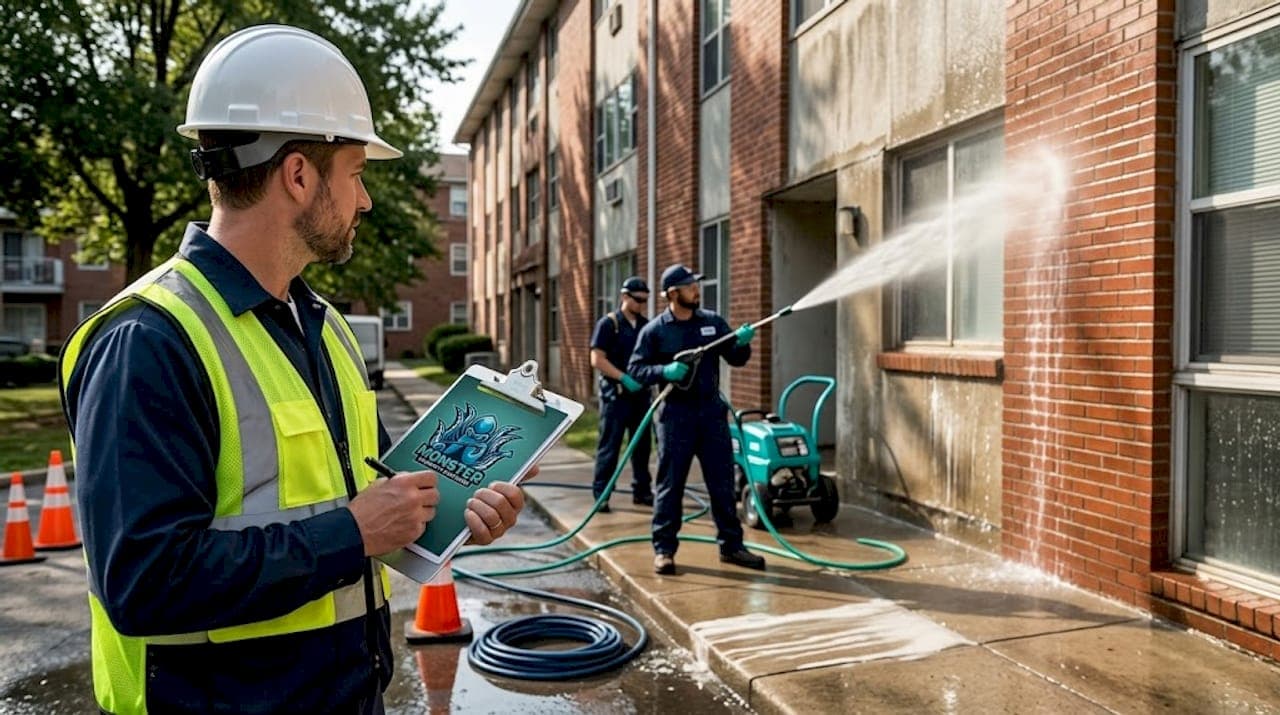
Most construction managers categorize power washing alongside landscaping or window cleaning as "nice to have" maintenance line items that get cut first when budgets tighten. That assumption is costing multi-family owners tens of thousands of dollars in accelerated repairs and premature repaints. Power washing extends paint life by 3 to 5 years, saves significant money in deferred maintenance, and typically delivers a 100 to 200% ROI. This guide breaks down exactly why, and exactly how to put it into practice across your portfolio.
Table of Contents
- Why power washing is essential for multi-family projects
- Measurable cost savings and ROI from power washing
- Operational best practices: How to get top results
- Scheduling and planning for maximum impact
- What most construction managers miss about power washing ROI
- Expert support for your multi-family power washing
- Frequently asked questions
Key Takeaways
| Point | Details |
|---|---|
| Protects property value | Routine power washing keeps buildings presentable, extends lifespan, and helps avoid surprise repairs. |
| Delivers high ROI | Managers typically see a 100–200% return on investment in power washing through delayed repaint and reduced major repairs. |
| Best done seasonally | Cleaning every season or more in high-traffic areas ensures compliance and maximizes life of exterior surfaces. |
| Requires expert process | Pre-treatment, proper dwell time, top-down rinsing, and landscape protection are essential for the best results. |
Why power washing is essential for multi-family projects
Multi-family properties face a level of exterior wear that single-family homes simply do not. Between dozens of residents, constant foot traffic in shared spaces, vehicle exhaust in parking structures, and the mechanical wear of HVAC systems venting onto exterior walls, the surface degradation happens faster and spreads wider. Environmental pollutants, algae, mold spores, and hard water deposits do not stay on the surface. They work their way into porous concrete, brick mortar, and painted siding, weakening the substrate itself.
Routine pressure washing for multifamily properties is not just about appearances. It is a direct line of defense against the following risks:
- Mold and mildew growth: Moisture retained in surface grime creates ideal conditions for mold colonies, which can spread to building interiors and trigger health code violations.
- Paint and coating failure: Dirt, algae, and mineral deposits accelerate paint oxidation and cause premature peeling and bubbling, forcing costly repaints years ahead of schedule.
- Surface deterioration: Embedded biological matter and pollution accelerate the breakdown of concrete, stucco, and brick, leading to structural repair costs that dwarf the price of cleaning.
- Compliance exposure: Many municipalities and HOA agreements require buildings to maintain clean exteriors. Missed inspections can result in fines that are entirely preventable.
- Resident satisfaction and retention: Dirty common areas directly impact lease renewals. Research consistently links property presentation to renewal decisions.
"Regular exterior cleaning directly protects the structural integrity and market value of multi-family properties, keeping compliance risk low and resident satisfaction high."
Industry experts recommend seasonal cleanings for multi-family properties, with power washing performed at least four times per year for apartment complexes and more frequently for high-traffic areas like entryways, breezeways, and parking decks. For construction managers handing off completed buildings or overseeing ongoing renovation projects, setting up this schedule at project handoff protects your workmanship and limits warranty callbacks.
Measurable cost savings and ROI from power washing
Here is where the conversation shifts from maintenance philosophy to hard numbers. Power washing is not just reasonable spend. It is one of the most defensible line items in your maintenance budget when you stack it against the alternatives.
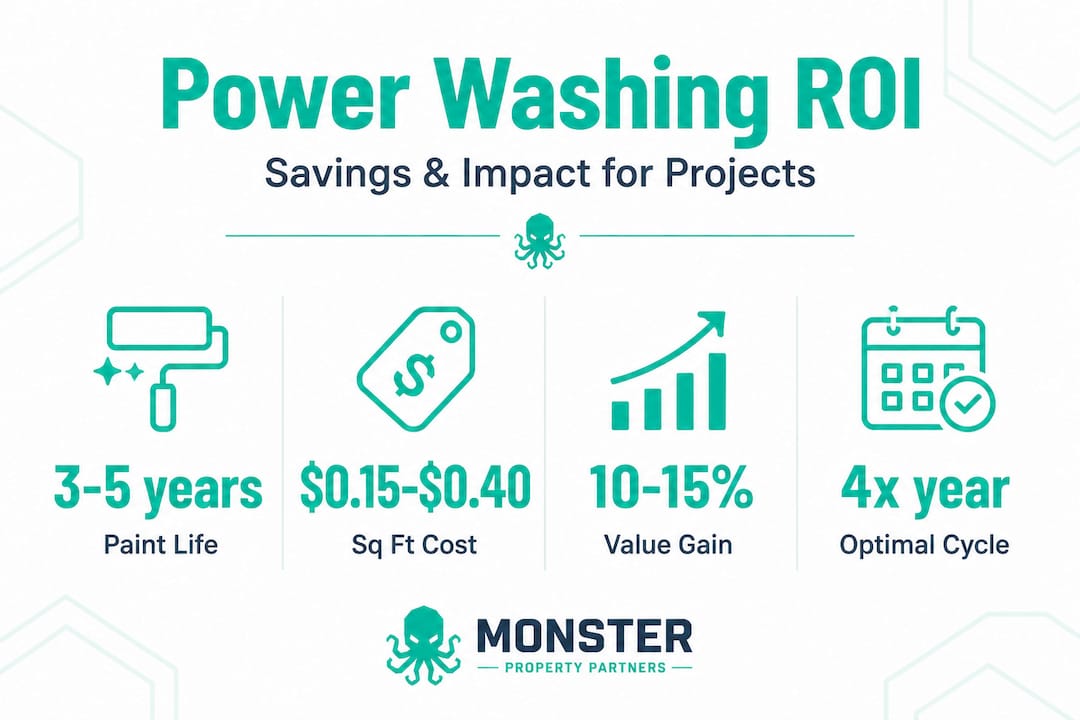
Power washing costs $0.15 to $0.40 per square foot for building exteriors and delivers 3 to 5 additional years between full repaints, with ROI ranging from 100 to 200%. Put that against what a full exterior repaint or siding replacement actually costs on a 100,000 square foot complex, and the math becomes impossible to ignore.
Cost comparison: Power washing vs. deferred maintenance
| Maintenance Action | Cost per Sq Ft | Frequency | 10-Year Total (100K sq ft) |
|---|---|---|---|
| Power washing | $0.15 to $0.40 | 4x per year | $60,000 to $160,000 |
| Full exterior repaint | $1.50 to $3.50 | Every 5 to 7 years | $300,000 to $700,000 |
| Stucco or siding repair | $3.00 to $8.00 | As needed | Highly variable |
| Mold remediation | $10.00 to $25.00 | As needed | $50,000+ per incident |
The concrete pressure washing value impact extends beyond the building shell. Clean driveways, pool decks, and parking areas retain their surface integrity significantly longer than neglected ones. Concrete that is regularly cleaned does not develop the embedded grease, oil, and organic growth that eventually requires grinding, resealing, or replacement.
From a property value perspective, studies on pressure washing and property value consistently show that well-maintained exteriors correlate directly with higher appraisal values and faster lease-up timelines. In competitive rental markets, curb appeal is not cosmetic. It is a revenue driver.
Pro Tip: Schedule your power washing cycles to align with seasonal transitions, spring and fall in particular. Post-winter cleaning removes road salt, debris, and biological growth that accumulated during cold months. Pre-winter cleaning clears the surface before freeze-thaw cycles can push contaminants deeper into porous materials.
Operational best practices: How to get top results
Understanding the ROI is powerful, but execution matters. A careless power washing job can strip caulk, drive moisture into wall cavities, and damage landscaping. The difference between a productive clean and a costly mistake comes down to technique, chemistry, and sequencing.
Follow these steps for safe, effective results on multi-family exteriors:
- Conduct a pre-wash inspection. Walk the building and document existing damage, loose caulk, cracked mortar, and compromised paint. Cleaning these areas before repairs simply washes the problem away and delays proper remediation.
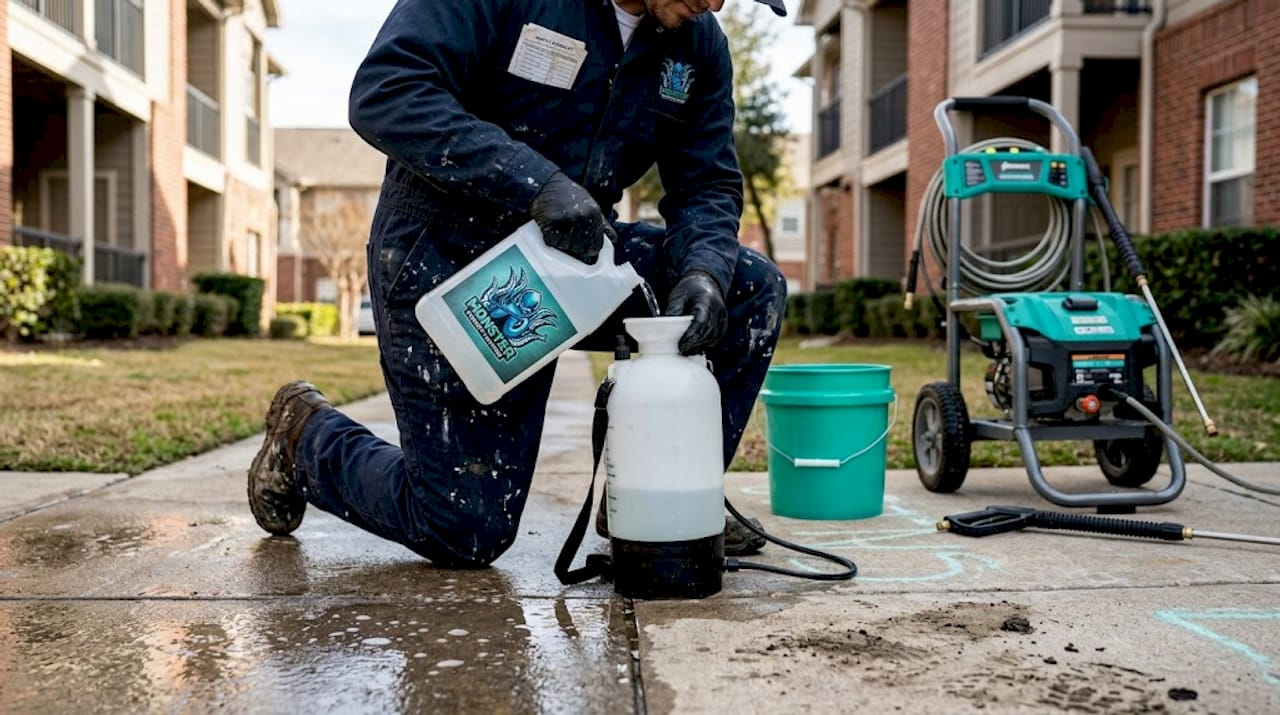
- Apply pre-treatment chemicals. Use appropriate surfactants or biocidal cleaners for the contaminant type. Mold requires different chemistry than traffic film or mineral deposits. Allow the cleaner to dwell for 5 to 10 minutes before rinsing to break down the bond between contaminants and the surface.
- Protect landscaping and fixtures. Cover shrubs, electrical fixtures, exterior lighting, and HVAC intakes before beginning. Pre-wet plantings with clean water so chemical overspray is diluted on contact.
- Rinse from top down. Always work from the highest point of the building down to prevent dirty runoff from coating already-cleaned surfaces. Use appropriate pressure settings for each surface type: lower pressure for painted wood or EIFS stucco, higher for concrete or brick.
- Neutralize pH after treatment. Alkaline cleaners used on concrete or masonry must be neutralized with a mild acid rinse to prevent long-term surface damage. Skip this step and you risk accelerating the very deterioration you were trying to prevent.
- Document the completed work. Photograph before and after, log the date, chemicals used, and surfaces cleaned. This documentation protects your project warranty and creates a compliance record.
The maintenance pro tips that separate average results from excellent ones almost always come down to pre-treatment and neutralization. Most shortcuts happen in those two steps.
Cleaning method comparison: With and without pre-treatment
| Method | Surface Result | Long-Term Impact | Risk Level |
|---|---|---|---|
| Pre-treat + dwell + rinse | Deep clean, stain removal | Paint lasts 3 to 5 years longer | Low |
| Rinse only, no chemical | Surface clean only | Biological regrowth within weeks | Medium |
| High-pressure without pre-treat | Surface damage possible | Forces moisture into substrate | High |
The exterior cleaning best practices for multi-family properties always prioritize surface compatibility. A concrete parking deck tolerates 3,000 PSI without issue. The same pressure on fiber cement siding or EIFS can cause immediate, expensive damage. Your crew or vendor needs to distinguish between surface types and adjust accordingly before the trigger is pulled.
Pro Tip: Protect not just the landscaping but also exterior-mounted cameras, intercom panels, and unit number placards. These items are frequently damaged by direct pressure washing contact and cost more to replace than the masking tape used to cover them.
Reviewing multifamily exterior projects from start to finish shows that the pre-job walkthrough is where most failures are prevented.
Scheduling and planning for maximum impact
Once methods are understood, the final key is getting the timing right for the biggest payoff. A single annual clean does less for your building than four well-timed cleanings, even if the annual clean uses more time and more product per session. Frequency and timing are what transform power washing from a reactive task into a proactive protection strategy.
Power washing seasonally, four times a year, is the baseline recommendation for apartment complexes, with additional cleanings for high-traffic common areas as conditions warrant. How you build that schedule depends on several factors:
- Climate and seasonal exposure: Properties in humid southeastern states accumulate mold and algae faster than dry southwestern markets. Northern properties face road salt contamination through winter. Match cleaning frequency to your actual environmental conditions.
- Occupancy rate and resident turnover: Higher occupancy and faster turnover generate more surface contamination in entryways, breezeways, and laundry rooms. Plan additional cleanings around peak turnover seasons.
- Local regulations and HOA requirements: Some municipalities require documented cleaning records for multi-family properties. Know your local code before setting your schedule so your documentation satisfies compliance requirements.
- Warranty and insurance considerations: Some building material warranties and commercial property insurance policies include maintenance requirements. Documented cleaning cycles can prevent warranty claims from being denied.
- Upcoming inspections or lease-up events: Schedule a cleaning 10 to 14 days before a major property inspection or new lease-up campaign to ensure the building presents at its best without the risk of water spotting from a wash done too close to the event.
Your seasonal cleaning checklist should include not just the cleaning itself but the pre-inspection, post-cleaning inspection, and documentation step for each cycle. This makes your exterior maintenance program auditable and defensible to ownership groups or investors.
The apartment cleaning schedule tips that work best in practice involve coordination between your maintenance team and your contractor at the start of each year, not reactive scheduling after a problem becomes visible. Pre-scheduling also gives you leverage on pricing with vendors.
Pro Tip: Keep a maintenance log that tracks each cleaning date, the scope of work, the vendor or crew used, weather conditions, and any deficiencies identified. This log becomes invaluable when you need to defend maintenance decisions to investors, respond to warranty claims, or demonstrate compliance during inspections.
The seasonal pressure washing essentials for multi-family properties are not complicated, but they do require intentional planning. Build the schedule in January, pre-book your vendor, and treat exterior cleaning as a fixed operational commitment rather than a discretionary spend.
What most construction managers miss about power washing ROI
With all the actionable steps laid out, let's pause and consider the deeper perspective most managers overlook.
After working with construction managers across hundreds of multi-family projects, the consistent pattern is this: managers who see the biggest return from power washing are not the ones who optimize pressure settings or chase the lowest per-square-foot price. They are the ones who recognize that regular cleaning converts unpredictable maintenance events into predictable, budgeted line items.
Think about what a mold remediation event actually costs. It is not just the remediation invoice. It is the resident relocation, the potential legal exposure, the time diverted from your primary project, and the reputational damage that ripples through lease renewals. All of that is preventable with a quarterly cleaning cycle that costs a fraction of a single incident.
The managers who still see power washing as cosmetic are inadvertently running a risk management strategy that depends on luck. Grime and biological growth are not visible warning systems. The costliest problems, moisture intrusion behind peeling paint, spalling concrete from embedded salts, mold colonies behind fascia boards, develop invisibly until they become major failures. By the time you can see the problem, the damage is already done.
Seasonal power washing reframes your entire maintenance model. When you clean consistently, you also inspect consistently. That means deficiencies get caught at the hairline crack stage, not the water-damaged drywall stage. Stakeholders and investors understand and respect a proactive maintenance plan far more than a series of emergency repair invoices, and the documentation you build along the way makes your budget requests substantially more credible.
Expert support for your multi-family power washing
If you want hassle-free, reliable power washing, proven experts can help streamline your exterior maintenance plan.
At Monster Property Partners, we work specifically with construction managers and property teams handling multi-family portfolios. We understand that your standards are high, your schedules are tight, and the margin for error on large exterior cleaning projects is minimal.
Our team handles everything from full building exterior cleaning to concrete cleaning for common areas, using professionally calibrated equipment and industry-standard chemical protocols that protect your surfaces while delivering deep, lasting results. Whether you need to set up a quarterly schedule or handle a pre-inspection clean for a major property, we make the process simple. Explore our multifamily exterior cleaning services and request a quote to get your exterior maintenance program on a professional footing.
Frequently asked questions
How often should multi-family buildings be power washed for best results?
Seasonal power washing four times per year is the standard recommendation for apartment complexes, with increased frequency for high-traffic shared spaces like entryways and parking areas.
How much does power washing typically cost for multi-family properties?
Building exteriors run $0.15 to $0.40 per square foot, while parking areas and sidewalks typically fall in the $0.08 to $0.25 per square foot range depending on surface condition and square footage.
What are the main benefits of power washing for construction managers?
Regular cleaning extends paint life by 3 to 5 years, reduces long-term maintenance costs measurably, supports compliance, protects structural integrity, and delivers ROI well above the cleaning investment.
What best practices should be followed during power washing?
The essential steps are pre-treating surfaces with appropriate chemistry, allowing 5 to 10 minutes dwell time, rinsing from top to bottom, neutralizing pH afterward, and protecting landscaping and building fixtures throughout the process.